I met Richard Bushong today. He is 88 years old and done his fair share fir his country. He served as a pilot with the American airforce through WW2, Korea and Vietnam. At the age of 19 he was flying B-17 Flying Fortresses over Germany and he finished his career with the airforce flying Phantom jets over Vietnam. What an amazing life. I met him at the Pima Air and Space Museum in Tucson.
This museum is one of the largest air and space museums in the world. To enjoy this place it helps to be a bit of a plane nutter. I’m not extreme but there are I few planes I wanted to get close and personal with and you can do that here. The beautiful F111 is one and I believe Australia, until recently, was the only country in the world still flying them. To me they are a beautiful plane and have been an effective workhorse for the Australian Air Force.
Do you remember the U-2 spy plane. It’s photos first revealed the missile sites on Cuba that sparked the Cuban Crisis and one was shot down over the then Soviet Union in 1960 I think. This revealed to the world that America was spying on the Soviet Union. Well there aren’t any of those left but the amazing SR-71 Blackbird Spy Plane that followed the U-2 is here.
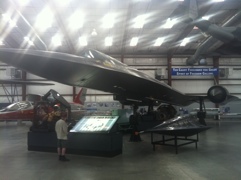
The sinister and beautiful ‘Blackbird Spy Plane’.
This plane could travel at Mach 3 (three times the speed of sound) and higher than any airplane has ever flown. It’s shape is like no other and it looks both beautiful and sinister at the same time. Surprisingly it’s tyres are no bigger than your average car tyre but made of special materials to withstand the extraordinary forces on landing. To manage such speed it’s engines used scramjet technology. It was so specialised for speed and altitude it’s travel range was incapable of reaching the Soviet Union so they developed a drone that piggybacked the Blackbird and went the rest of the way. I don’t think it was ever used. Of the sixty Blackbirds produced, only 30 survived. Anyway I could go on and on.
The B-52 Bomber is here. Its wing span is so large it has a wheel at each wingtip to stop them hitting the ground. They were developed in the 1950s and use extensively during the Vietnam War to bomb the supply routes and jungles of Vietnam and Laos. Their terrible legacy is still being felt today over there with many of the bombs dropped still remaining unexploded but dangerous. Surprisingly some of these planes are still in service and hold the record for being in service longer than any other military plane. Three generations of pilots have flown these things.
Not far from the museum is what used to be known as ‘the boneyard’. It’s a place where disused military aircraft were brought to be scrapped. Today it is a place for military planes to be mothballed or recycled. Why here? The desert air keeps the rust away and the soil is a type of clay that doesn’t allow water to penetrate, so no bogging. Planes to be stored for possible reuse are flown in, washed and coated in a special latex-type coat to protect from the sun. There are thousands of them here. Then in another section the planes are set up for recycling. Parts are removed and sold. This place is run by the Department if Defence and sale of parts is a serious money spinner for them. There are F111s here that are broken up and parts sold to Australia. The area here is huge and there are planes of all sorts everywhere. Parts and whole planes are sold over the Internet.
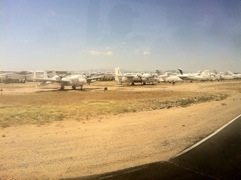
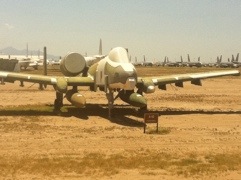
I return to Phoenix by bus to fly out tomorrow for New Orleans.
 angusmccoll