‘To think that a civilization with the mind, desire and ability to create something of this magnitude could be completely destroyed by a civilization with purely materialistic ambitions is just wrong. Humanity took a giant step backwards that day.’
Angus McColl
Matchupicchu means ‘big mountain’ and is a modern name given to the famous Inca city because nobody knows what name the Incas gave the place. Another point of interest before I start describing my day – the word ‘Inca’ is not the name of a people’s but I title. Incas were king-like leaders.
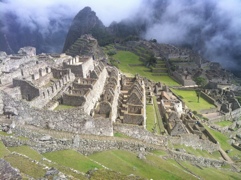
Apart from it’s impossible location and amazing architecture, Matchupicchu was an extraordinary place for other reasons. It was home to an elite group of people’s, chosen to be there by the Inca. They were at the clever end of the social scale – teachers, doctors, agriculturalists, artists and more. And of course architects and builders. Everything about the story of this place is conjecture and the Peruvians admit that. The guides are careful to add ‘It is our opinion that…’ to everything they tell us. Apparently this amazing city was only home to about 500 people!
There had to be laborers and they came from outside. Instead of paying money for taxes, the people from the region were required to provide one months labour each year to the city of Matchupitchu. For a month each year they would come into the city and work. And work they did! The Inca Trail, now popular with tourists, was the main access to Cuzco and supplies. At that time Cuzco was a large Inca city. The trail today is only half the distance of the original path.
The city is built atop of a mountain. If you were to think of the most unlikely place to build a city, this would be it. Experts think the Incas built here to protect its precious population from enemies. It is also thought they wanted to be as close to their Gods as possible. And access to the right building materials was important too. They used the local granite.
We start the day at 5 am. You can either choose to walk up the steps to the entrance of Matchupicchu or take a bus. The walk is tough and takes an hour and a half. To preserve energy for plenty of walking around the city I decide to bus up and do the steps down. It’s raining this morning so bussing it was a good choice. We get up the amazing looping road around 6.30pm. We start our visit to the city with a 2-hour guided tour and that is where I have got the information from for this blog.
That famous rock wall construction that is unique to Incan architecture is perfection. The whole city isn’t built of it though, only special parts including the Inca’s residence (of course) and places of worship. The rest was built of a simpler style of construction where a mortice was used to hold together not so perfectly fitting rocks. The morticed used has withstood 500 years of weathering. Nobody knows how they made this mortice. An attempt was made to duplicate it that only lasted two years. The classic Inca construction didn’t require mortice of any kind. The rocks were shaped to fit perfectly against each other. To do this they broke chunks of rock from granite boulders, then shaped and smoothed them with other harder rock into perfectly fitting blocks. The attention to detail for such a scale of construction must be unparalleled surely. To see this place was one of those ‘tears to the eyes’ moments for me, my second for the trip after the giant sequoias.
But there is much more to this amazing place. To be self-sustaining they needed to be able to crop. How do you do that on a mountain top? Terracing is how you do it. They built rock-wall terraces down the mountain side in places that simply look impossible. A pity the poor buggers that were sent to some of the crazy locations with instructions to build a rock wall. I would have taken a sickie that day! These terraces are all over and cover so much of the elevation of the city that the climate for cultivation varied from top to bottom. So crops were especially chosen for certain locations on the mountain edge. The soil was imported from the Cuzco region. Can you imagine that? The local soil wasn’t suitable so fertile soils were carried in over the Inca Trail.
Experts think there is much more of Matchupicchu yet to be revealed, hidden beneath dense rainforest. The magnitude of this place is enormous and takes more than a day to fully comprehend. Even the trail has some very sophisticated structures to make it possible. There is a bridge not far from the city that literally hangs off the side of a sheer cliff and this precarious structure, like the terracing, is intact all this time later.
Of course the development of Matchupicchu stopped with the arrival of the Spanish in 1521 (I think). The Spanish never found this place. They suspected it existed but failed to find it. Apparently a couple of German adventurers came across it in the 1850s and looted the site with the Peruvian governments permission. But it wasn’t until it was discovered by an American historian, Hiram Bingham, in 1911 was it revealed to the rest of the world. Lack of Government interest and protection at that time allowed Bingham to take many precious artifacts back to America.
Then there is Waynapicchu. It is a small steep peak at the back of Matchupicchu where there are more Inca ruins atop. Climbing Waynapicchu can be part of your visit to Matchupicchu and although a bit of an effort, is worth it. The Temple of the Moon lives here and you have to wonder, like the rest of the place, how they built this here. The views all around are insanely stunning, particularly the complete views of the city below.
The day ends with a train and bus ride back to Cuzco.
 angusmccoll
I am a little jealous… allways wanted to see it…
One day you must Andreas. It surely is very special.
Are you talking about Qld.