Today I visited the town where Hitler lost a testicle! Yes it’s true. He was caught in a shell blast here and as a result came out one ball less. How different things would have been if that injury had of happened to some part of his body he really did need! Perhaps this is what made him so cranky! He was also pretty pissed off at the way that war ended. To him Germany did not lose the war and technically he was probably right. The armistice that was signed on 11 November 1918 was a ceasefire that never resumed. Neither side had the desire continue fighting. The Treaty of Versailles that technically ended the war wasn’t signed until the following year. For Hitler the seeds of hatred for Jews were probably sown here. He saw them as sitting at home getting fat on the profits of war while Germans were being slaughtered on the battle field.
Anyway I’m not here to follow in Hitler’s footsteps. I’m here to follow in the footsteps of three relatives who were involved in the war effort here. My Grandfather and his two brothers all played a part here on what was known as the Western Front. They fought on the Somme, which is an administrative region on the Somme River and it saw some of the most atrocious moments of the war. The conditions on the Western Front were arguable some of the worst of any modern war. The winters here can be severe and weather records were broken during the terrible years of the war. Trenches filled with water, mud so deep and sticky men had to be dragged out by horse, soldier’s feet rotting from trench feet, snow, blizzards and more. Many young men chose to take their own lives and who could blame them. Millions from both sides died on this front are they are said to have given their lives for the greater cause here but to me that is a nonsense expression. Their lives were taken, many unnecessarily. Incompetent command was greatly responsible. Much of this war was under the command of the British, who employed outdated battle techniques developed from as far back as the Nepoleonic wars. They seem to have had little consideration for the advancement in war technologies. Frontal charges from the trenches were now met by machine-guns, not single shots, bows and arrows or spears! The Germans were no smarter. They were happy to throw their soldiers at certain death as well, until there was the last man standing. This was known as a war of attrition and our guide describes attrition as the devil’s arithmetic. I think he is right. It was the intention of the military commanders to keep throwing troups in there until the other side ran out of soldiers.
It wasn’t until towards the end of the war that Australian troops were finally united under an Australian commander, General John Monash. He introduced innovation and intelligence to the battle front, qualities completely foreign to British commanders. He wanted to maximize effect with minimal loss of life. What a novel approach! I could be wrong but I think he may have invented the technique of ‘creeping artillery’ – where soldiers advance behind a forward creeping line of heavy artillery. This didn’t always work. There was a famous instance where allied forces were advancing into a strong gale and the shells were falling short because of the wind onto their own men. Monash had many important successes. Why did it take so long for him to be put in charge? He was an Australian, of Jewish heritage and from a humble background. He did not fit in with the elitist British command. Even after his successes he was never properly recognised. To my mind the war in Europe would have been shorter if he had have been given proper command earlier.
Where we are visiting today was the frontline. Over the life of the war this line went back and forth, in just meters in some places, a few kilometers in other places, but at the cost of millions of lives. It was an insane standoff. Many of the villages we are visiting were taken over by the Germans and suffered terribly at the hands of the German soldiers. These villages were eventually won back by Australian and New Zealand troups and the locals are forever grateful. Australian flags fly and museums tell the stories. Villers Bretonneux has streets and shops named after Australia places.
There are monument cemetries all across the land here. Between the villages is farmland and the rolling hills are covered in crops of all sorts. A common one is sugar beet which has just been harvested. It’s like a large turnip and it is Europes way of making sugar. No sugar cane here. It sits in the side of the road in huge piles awaiting collection. The cemeteries around here are full of Australians. But not all Australian dead made it to a cemetery. On this tour with me is Leeta and her mother. They are from near Mildura in Victoria after moving from Cairns.
Leeta would be in her mid twenties and has extraordinary knowledge of the battlefields here and the areas her relatives fought. She took us out into a paddock now under crop where several Australians are known to lay according to her research. The ground is wet from morning rain and the history books talk of the sticky impossible mud the soldiers had to deal with. I can confirm it is amazingly sticky. Like a magnet it grabs onto my shoes like no other mud I have experienced. Today, 5 November, is the anniversary of a major offensive of the allied forces. Amazingly most of the roads and tree lines I’m looking at today are exactly as they were back in 1918. the trenches and crater marks are gone but farmers are still digging up shells, grenades and other armaments. They just pile them up in a corner of the paddock. Many are still active and accidents happen frequently, 90 years later!
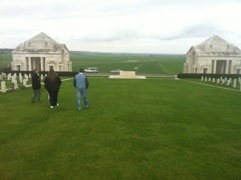
The beautiful peaceful Villers Bretonneux war memorial cemetery.
The biggest monument and cemetery for Australians is just outside the quaint village of Villers Bretonneux. Anzacs took this village back from the Germans at great cost. Each year a dawn service is held here. It’s a beautiful peaceful place and I’m told many local French people come here for quiet contemplation. There is a tower and large wall of names at the back. The tower has bullet holes in it from a mischievous Messerschmitt pilot from WW2. Interestingly these memorial cemeteries were put in place just prior to the Second World War. Hitler gave instructions for these sacred places to not be destroyed. The memorial at Saint Quentin had a statue of an Anzac bayonetting an eagle, a symbol of the Third Reich. The German soldiers of WW2 found that offensive and removed it but apart from that they mainly complied to Hitler’s wishes.
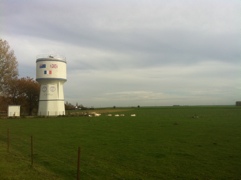
The water tank on the left was the German front line while a tree line, just out of view on the right, was where the Australian troupes were trenched. So close they were probably cursing each other.
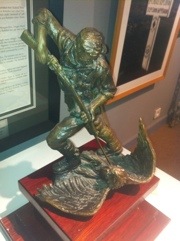
A model of the statue found offensive by the Germans in WW2 so they removed it from the Saint Quentin war memorial.
 angusmccoll
Sounds like you are having a very interesting trip. You are certainly good at blogging and relaying your feelings and what you are actually seeing. We are sooo looking forward to you coming to visit and making big plans etc can’t wait to see you in the next couple of days and hearing about your adventures first hand. The most important thing in all your difficulries is that you are still safe yourself and in one piece. Take care
karen
Thanks Karen. Yes I have survived mainly intact so far! Let’s see what Dubai does to me! I am very much looking forward to seeing you again, and in your new home. Not long now. I catch the train via the sub English channel which will be a bit daunting then onto the plane tomorrow night. I’m very excited to Finnish my adventure with you both. See you soon.
Perfect for remembering. Thanks Angus