‘My name is Phong and I am your guide today. I’m 29 years old and still not married. My parents worry. I’m not worried. Still plenty of time. There are two Vietnamese women on this tour. They are very beautiful’. Phong either wears his heart on his sleeve or he could easily get a gig in stand-up comedy. He is funny.
There are about 15 of us on this tour that will take us out of Ho Chi Minh City westward and close to the Cambodian border. We are going to visit Cao Dai Great Temple near Tay Ninh, then go onto a network of tunnels successfully used by the Viet Cong during The American War. They are near a town called Cu Chi and are known as the Cu Chi tunnels.
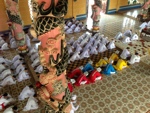
Prayer in progress at the Cao Dai Great Temple.
The Cao Dai Great Temple is the headquarters of a uniquely Vietnamese religion called Cao Daism. It’s a fusion of Buddhism, Confucianism and Christianit,y and that is reflected in their tri-coloured flag, yellow, blue and red. As well as the temple, the complex houses admin offices, officials’ residences and a hospital of traditional herbal medicine. But it is the temple of course that stands out spectacularly. Not only is it huge but very colorful as well. And ornated all over with sculptures of elements of the religion. Dragons feature, as does the lotus flower but probably the most significant symbol is the single eye in a triangle where the points of the triangle represent heaven, hell and earth.

Cao Daism has several million followers world wide. Vietnamese generally aren’t that concerned by religion with only about 20% admitting to following a faith. Buddhism is probably most popular.
For lunch the tour drops into a designated tourist cafe. I hate these places. They are over priced and full of processed crap and bad service. I deliberately avoid them plus I prefer to support other parts of the village. This comes with its challenges though. It’s unlikely you will find English in these local eateries. I just shrug my shoulders and take what I am given – a mystery meal that is genuine and cheap.
The Cu Chi tunnels played an important part to the Viet Cong during the War. These impressive tunnels gave the VC underground access to Saigon, 65 kilometers away. They used this access to make surprise and demoralising attacks at the heart of the South Vietnamese regime. The Cu Chi tunnels are well set up for showing us all the tricks the VC used to attack their enemy and Phong seems to delight in showing us. Even some of the most hideous traps are explained with a bit too much exuberance. Bamboo spikes at the bottom of pits and swinging frames covered in spikes are just some of the bag-of-tricks that turn the stomach. But it is the tunnel networks that are impressive. The VC could live entirely underground for periods of time with underground food stores, water wells and kitchens that could cleverly disperse smoke to not give away the location. Three layers of tunnels were built in places at a maximum depth of 10 meters. On the surface they were invisible and the Americans could never get on top of this sneaky type of warfare. There is gun fire in the distance. At the end of these demonstrations of VC cunning was a rifle range where you could pay to try some of the weapons of this war. M16s, M60s and even the Russian AK47 were some of the guns you could try your hand at. I had a splitting headache already and spent the whole time with my fingers in my ears. I couldn’t get over how loud these damn things were in the jungle. What an un-nerving sound!
We also learnt how the VC made their uniforms underground and how they made their footwear out of recycled rubber tyres in such a shape that left directionless tracks. They thought of everything. Then there were demonstration tunnels made big enough for fat tourists to try. We did. What an experience. We crawled through this claustrophobic space for 60 meters. As clever as this tunnel living was, it was a tough life in the humidity and malarial infested environment that the rainforest offered.
 angusmccoll
I went there this year, it was pretty amazing! I loved the temple…