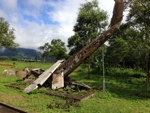
A huge US cargo and left behind at Khe Sanh
I’m doing a tour today. It’s 6am and I’m waiting for my bus on the steps of the travel agent where I bought my ticket. A middle-aged man and woman pull up in front of me on their motor bike, also carrying a large esky, plastic basket of stuff and about eight small plastic stools. I’m in their way and the woman gestures to me to move aside. She then proceeds to set up and within minutes, customers start rolling in. She is an instant breakfast cafe. Two school girls arrive on their push bike for breakfast, another lady comes for take-away, and another for a sit-down meal. I have seen another lady carry her business on her back. she had ones of those typical Asian slings that consist of a flattened pole with loads suspended from both ends. At one end were fresh vegetables and on the other was a large bubbling cooking pot complete with lighted fire. She would locate somewhere and start selling. Such is business in Vietnam.
It’s a big day today. The tour starts at 6am and we will return at 7pm. First stop is Khe Sanh, the site of a huge American military base up on a plateau just south of the old north/south Vietnam divide. At its peak in 1968 it accommodated 5,000 US marines and 1,000 south Vietnamese army. Today it is a monument to an embarrassing moment in the war for the Americans that ultimately turned the War against them. Poor intelligence had the US believing Khe Sanh was the centre of military attention. North Vietnam convinced them that they were planning a huge offensive on the base and while the US braced themselves here, north Vietnam attacked everywhere else, all at the same time. It was on the Tet holiday (30 January) in 1968 and it became known as the Tet offensive. The south Vietnam Army was caught napping. many troupes were celebrating the holiday. While this didn’t win the war for north Vietnam it provided the turning point. It was more of a psychological blow to the US particularly, because for the first time, Americans at home realized the War was not going the way they were being told.
Another failure of this base was its location. Based on a hill (khe sanh in local dialect), it was easily cut-off overland and unpredictable weather at seasonal times of the year made it difficult to access from the air. This led to supplies running precariously low at times.
There is little left at the Khe Sanh base now. There is a couple of tanks and a troupe-carrying helicopter, and a huge cargo plane on display. And there are also bits of helicopters collected together. The huge airstrip made from metal plates is gone, utilised by the resourceful locals. A museum gives a glimpse of what the base was like through static displays and photo,
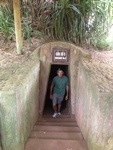
One of the many entrance/exits to the Vinh Moc tunnels
Next stop are the Vinh Moc tunnels. Near Saigon I visited the Cu Chi tunnels, which went for miles and were used by the Viet Cong to make surprise attacks on central Saigon. The Vinh Moc tunnels are very different. These tunnels, named after the local village, were built by the villagers to escape the American bombs. The tunnels formed a sophisticated network that could sustain a whole village for an extended amount of time. And where you had to crawl through the Cu Chi tunnels, these tunnels can be walked through comfortably. They had family living areas, a maternity ears and hospital, meeting rooms and kitchen. The network was multilayered. The first layer of tunnels went to 12 meters with the second layer down to 15 meters. The Americans countered with the ‘drilling bomb’. This bomb would drill into the ground to an amazing 15 meters before detonating. The villagers countered by digging special ‘drill bomb’ tunnels to 27 meters deep! The soil here is nearly solid clay so the digging would be laborious but reasonably soft. Seventeen babies were born over the six years these villagers had to endure the bombing. There are bomb holes every where. Over this time eight tons of bombs per person were dropped in this region.
On the way home we crossed the Ben Hai river that was the border between north and south Vietnam. There is a large memorial and war cemetery here for the North Vietnamese forces killed while fighting in this region. There are a lot of unmarked graves. To identify the dead, the Americans had dog tags. The north Vietnamese carried with them small medicine bottles with their details inside.
 angusmccoll