Kyoto is the heart and soul of Japan. It is the cultural capital. It used to be the administrative capital as well, before Tokyo. There are so many temples, shrines and beautiful gardens, many (if not all) are World Heritage Lusted. So many are there it is daunting choosing where to start. I have one and half days here so a select some temples in western Kyoto to explore. As with all of Japan, there is an amazing public transport system. I try the buses for the first time. It’s possible to simply get a day pass to access any of the public buses.
I start with Ninna-Ji temple, formally the Old Imperial Palace.
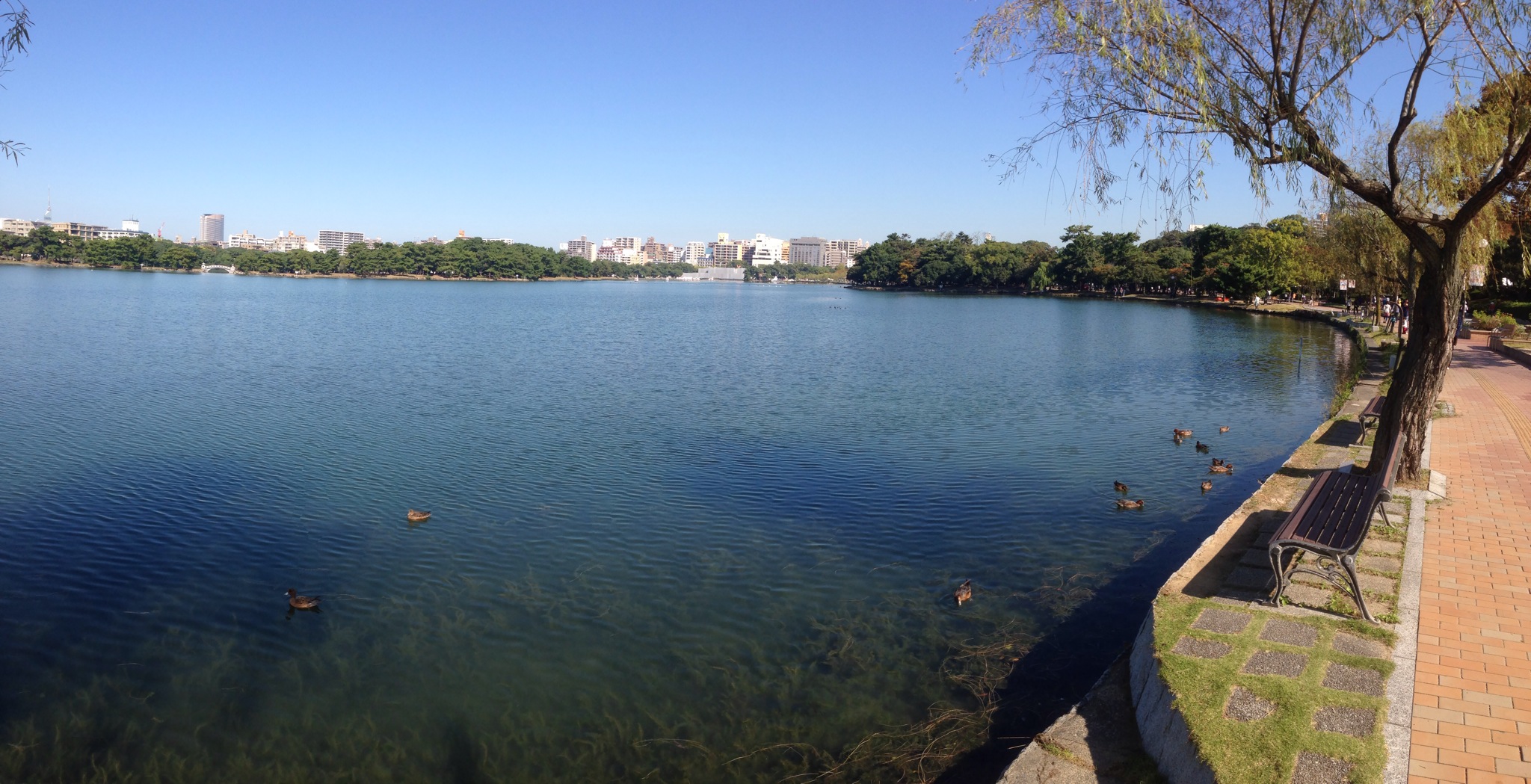
It’s a stunning day. I get up and visit the park across the highway again. It’s Saturday morning and many are jogging around the lake. And in typical Japanese style, they are all going in the same direction. It makes you feel like running in the opposite direction, against the flow, against the order. I wonder what they would do. Anyway…I feel a bit guilty sitting here enjoying my large coffee and scone.
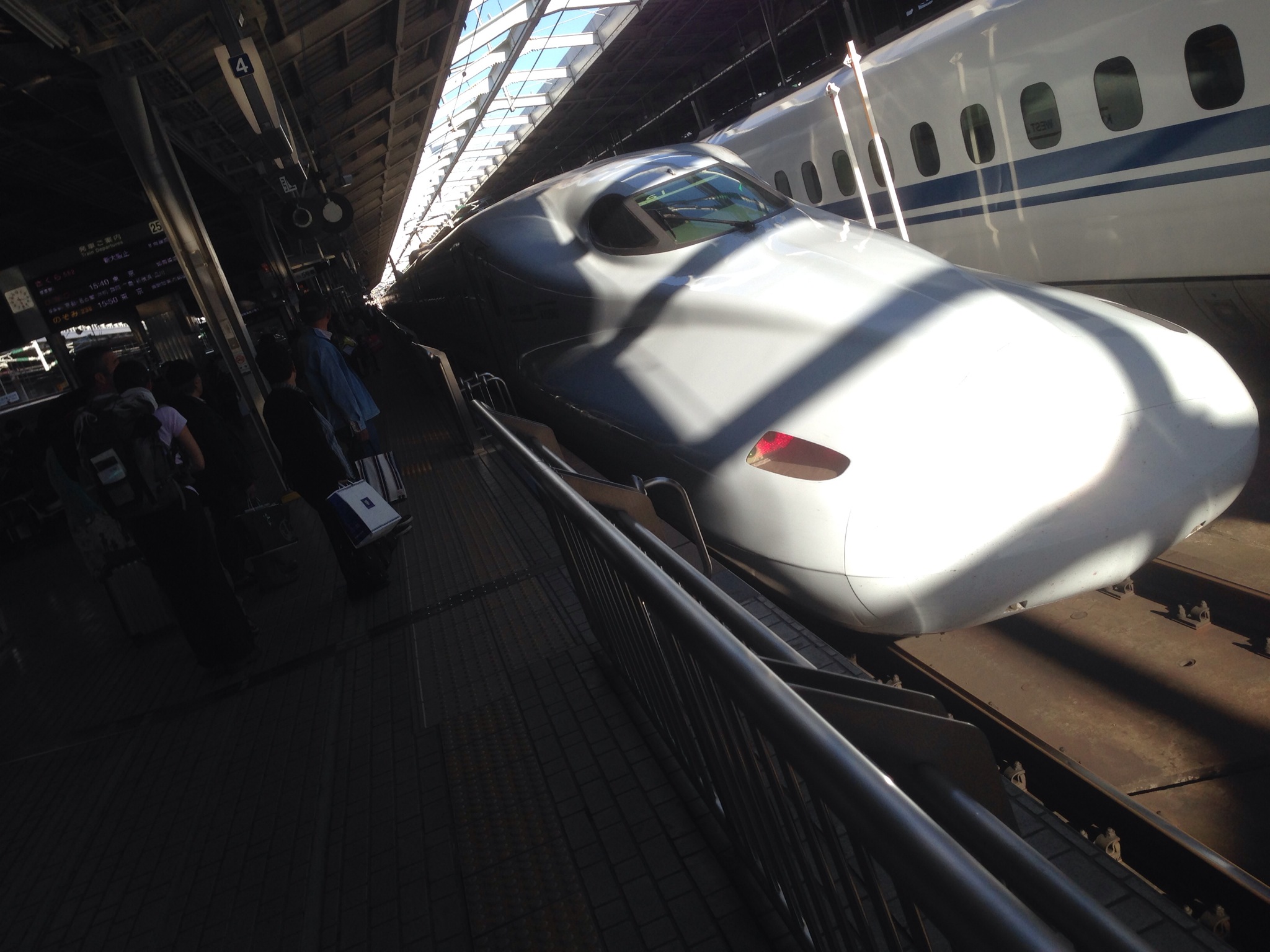
I aim for Kyoto today. Again I board the magnificent bullet trains (or Shinkansens). Many business men still prefer to use these trains for travel rather than planes. The cost is about the same but there is plenty of legroom, there are smoking spaces and you arrive in the middle of your destination with easy access to subways, trams and buses. And they are very comfortable. Much of western Kyushu has a rugged terrain so a lot of the trip is through tunnels, which is a frustrating for me. The hills are heavily forested with bamboos and trees I’m not familiar with. I always get a window seat to study the fleeting landscape as it passes by at great speed. Rice fields, market gardens and greenhouses patchwork the scenery between houses. The trains seem completely detached from the landscape. The tracks are high off the ground so you are looking down on everything except when going through tunnels. They must be a sight for the communities they slice through, though it’s not obvious. They don’t acknowledge them in any way as if we are invisible. The Shinansens are an amazing engineering infrastructure that would have been built from scratch because it’s such a specialised system, and truly one of the world’s great engineering successes I would think.
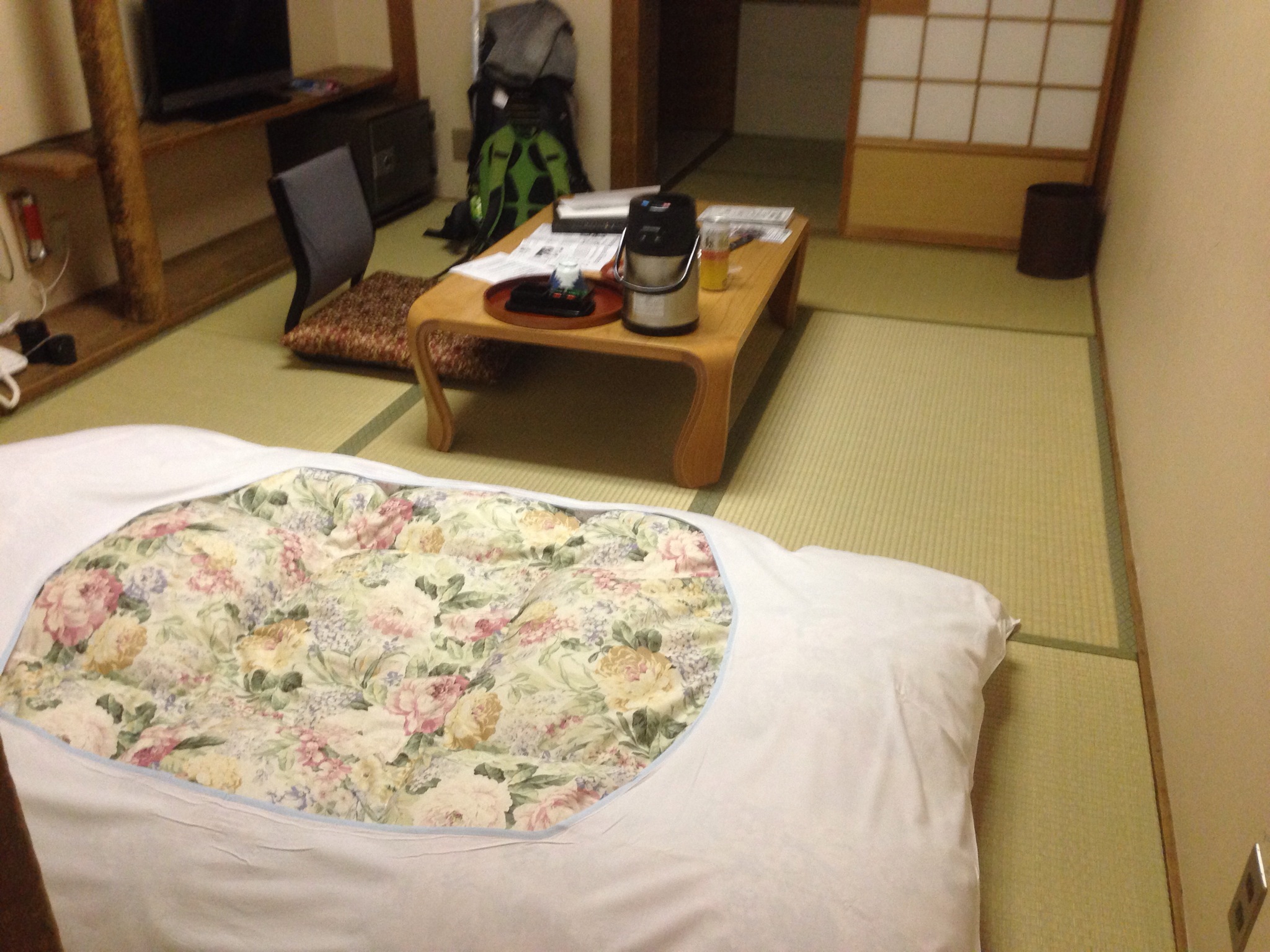
My hotel is very Japanese style with fibre mats, simple mattress on the floor, sliding wooden doors and public baths. Very nice. Hotel Honnoji is usefully located in the city centre.
I visit Ibusuki for the day. It is an easy 1-hour train ride from Kagoshima. Ibusuki is a popular seaside town for locals, not so much for the beaches because they are flat and the sand is black volcanic residue, but for the food and hot springs. As well as the hot spas, you can enjoy a sand bath here. These sand baths are popular. The brochures talk of serious therapeutic effects from the naturally heated sands. It claims to clean your blood. You strip off like for an ensen (or hot spa), then wrap yourself in a kimono. You then take yourself down to the waters edge where under a cover is a series of prepared sand beds. The sand has been heated directly by hot water from the local volcano. Attendants dig a bit of a hole, you lie down and they cover you. The weight of the sand is terrifying at first. It’s hard to breath and you feel like you’re being buried alive. It’s comfortably warm for a while then after 10 minutes, it’s enough. That’s all I could bear. You sweat like in a sauna. You drag yourself out then go indoors for a hot spa and bath. I enjoyed the experience.
The train gets me back to Kagoshima around 4.30pm. I had the hotel do my laundry today and It returns with every item individually wrapped in plastic!
I leave Kagoshima on the on the 9.42am bullet train. And when they say 9.42, they mean it. They leave dead on time. When they stop at a station you have about two minutes to get off and alighting passengers to get on. They announce when the stops are approaching and that is your cue to get ready and wait at the exit door. This is an extremely efficient system that is only possible with the Japanese tenacity for rules and order. It would never work in Australia.
I arrive at Fokuoka at 11.07am just as it said I would on the ticket. Starring out at me from the cover of a tourist brochure is Nick Cummins (or better known as the Honey Badger). He is an ex wallaby rugby player who has signed up to play in Japan for a season or two. He’s playing for a Coca Cola sponsored team here in Fokuoka. I manage to find my hotel via the subway.
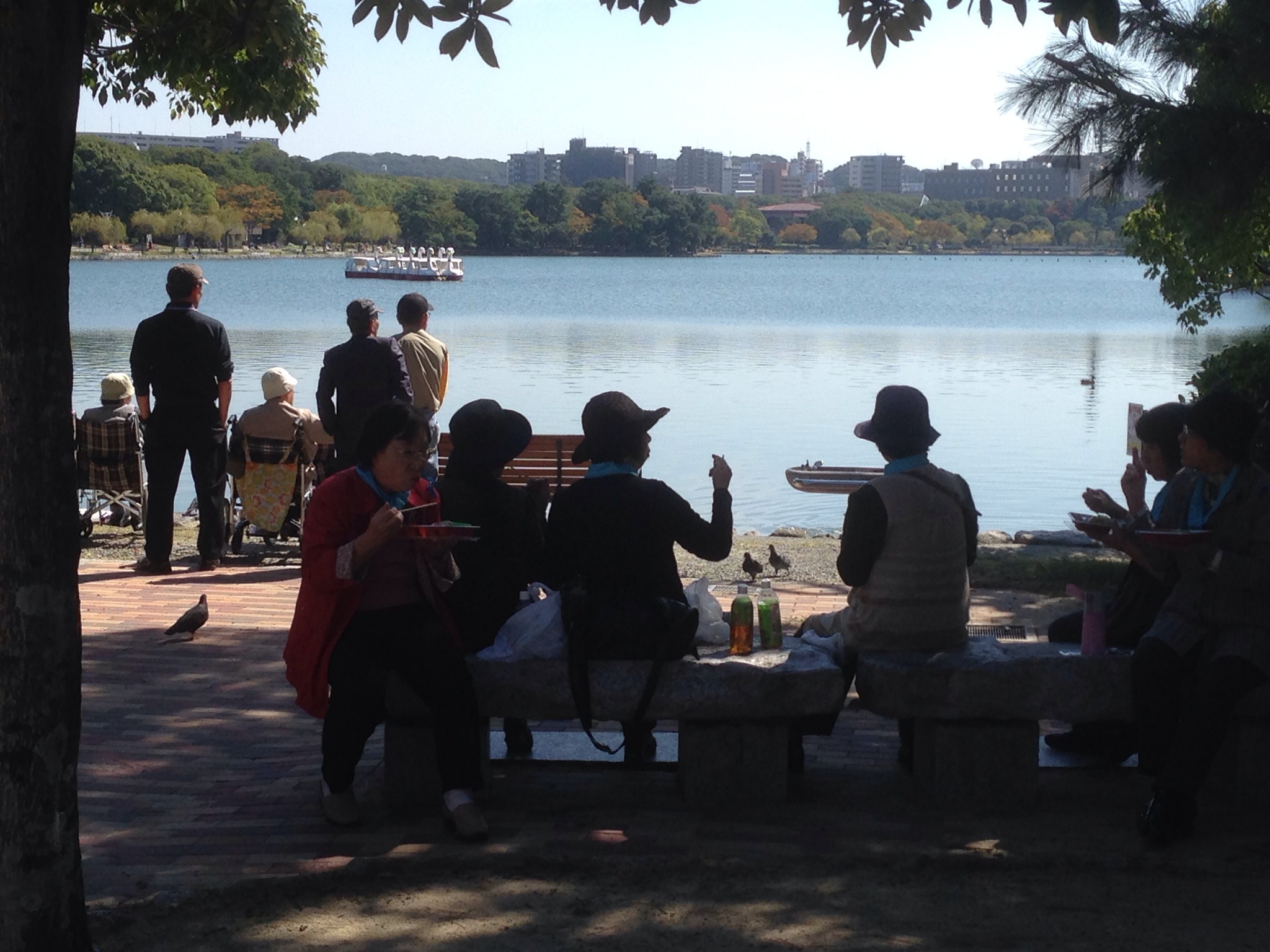
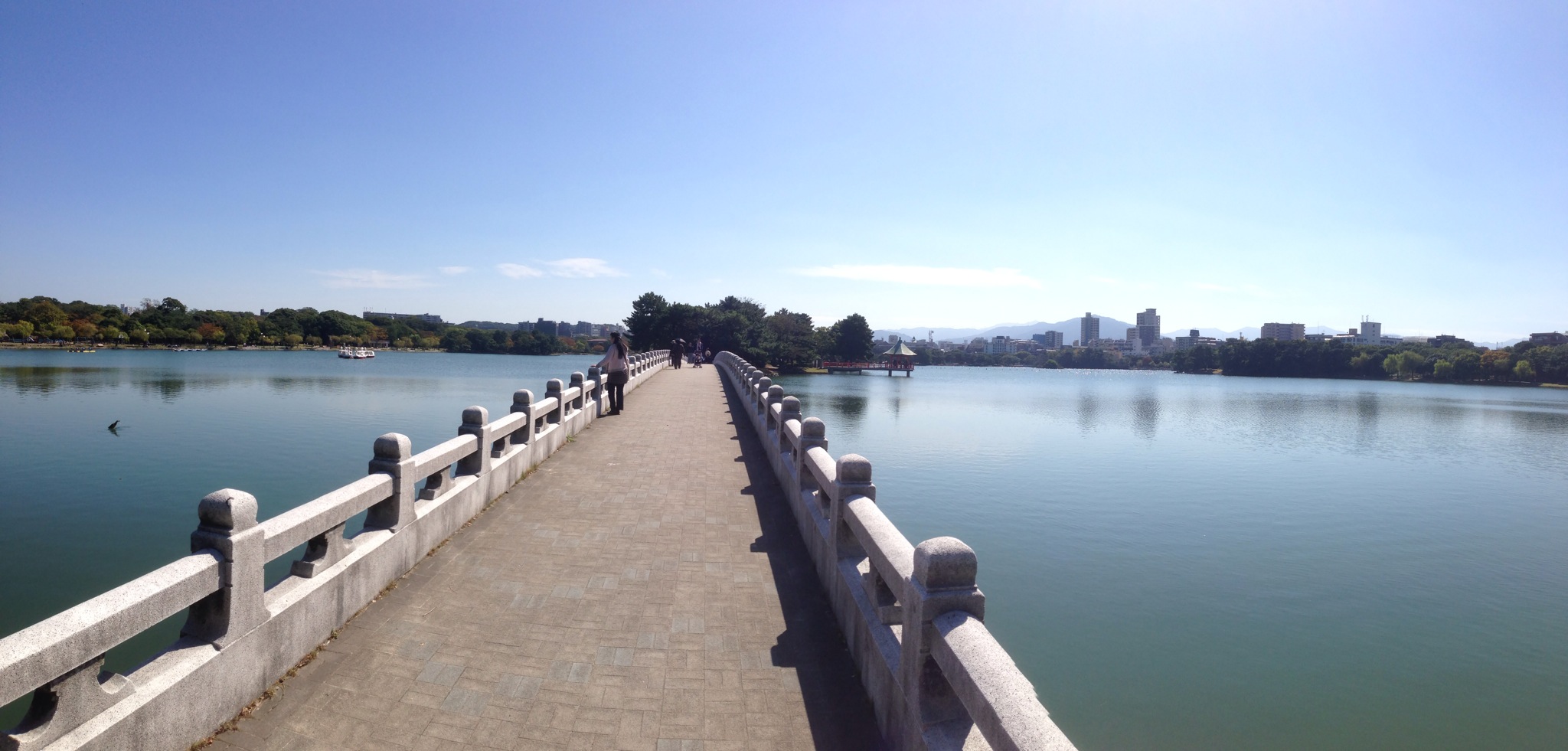
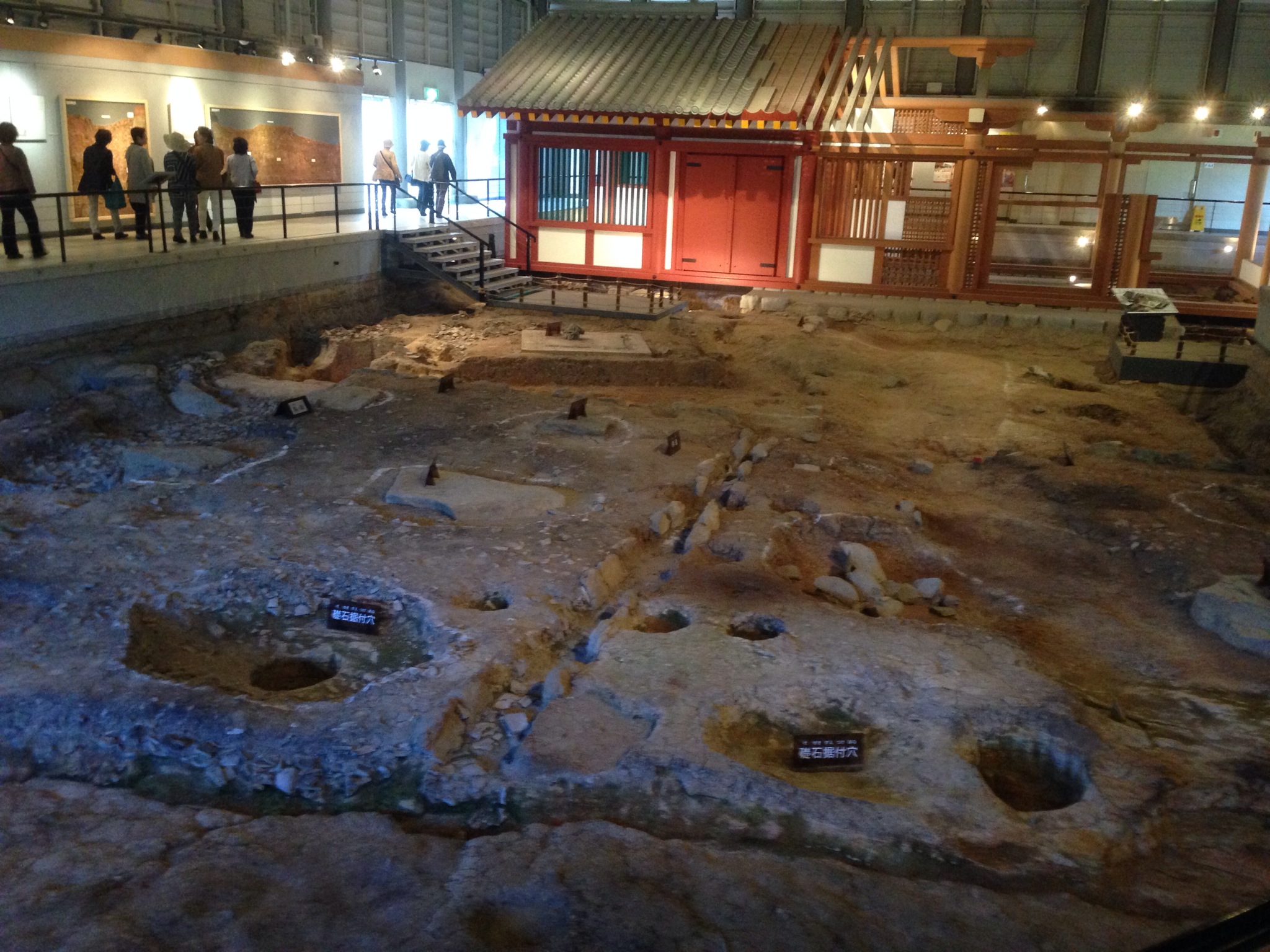
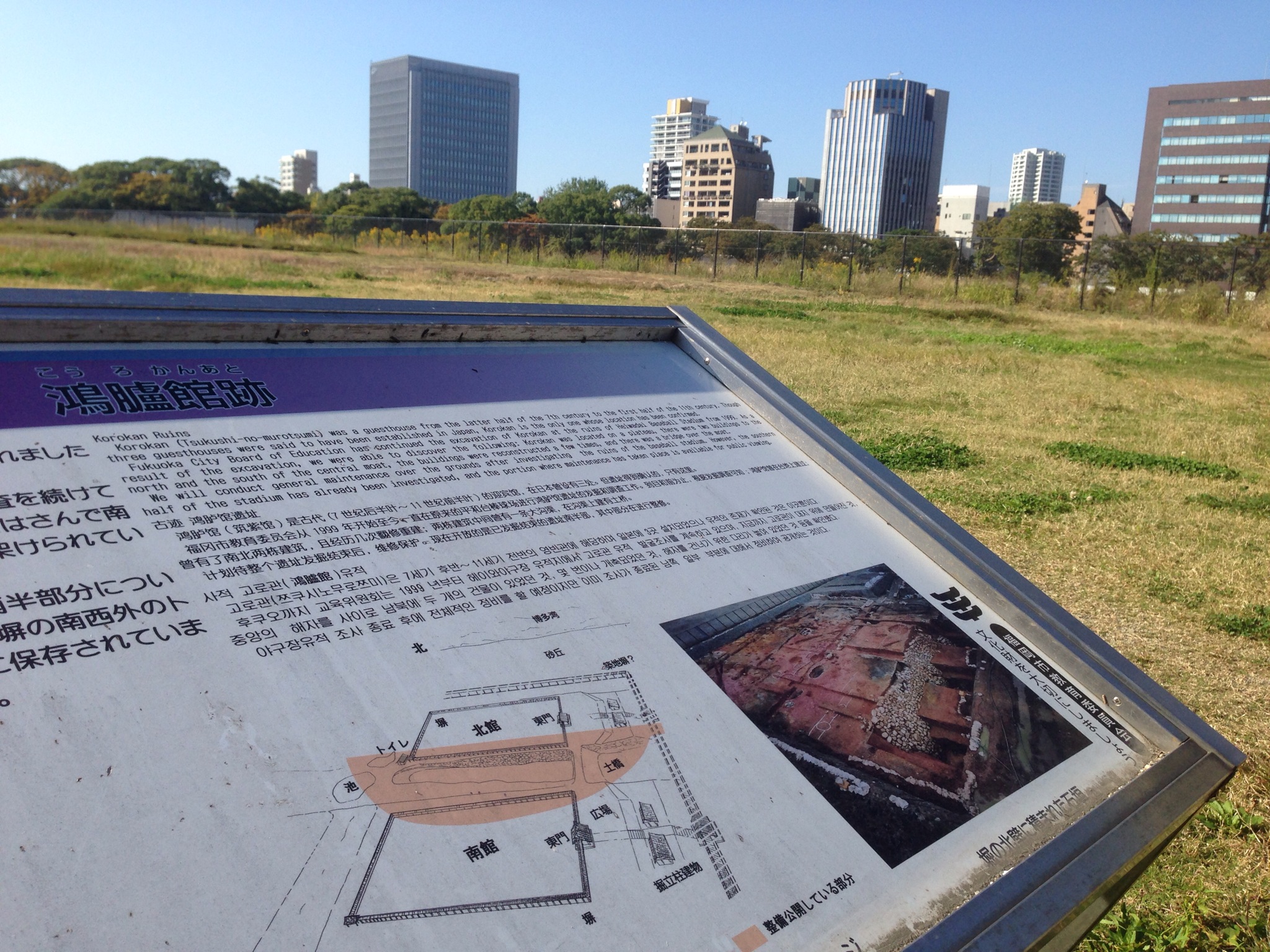
Across the highway is a park and historical area. The park has a lake and is a popular, comfortable public space surrounded by city. The historical area used to be a baseball stadium, which ironically led to preserving a very important archaeological site. There used to be a palace here but well before that, in the seventh century, it used to be a guest house or Korokan. These Korokans were Japan’s contact with the world. International diplomats were hosted here and Japanese diplomats launched from here on diplomatic missions. There were only three Korokans in all of Japan but only here in Fokuoka have they found hard evidence of one. The locations of the others are only speculations. Archaeologist know how far and wide this diplomacy travelled by the ceramics that have been dug up here. A palace was later built on top in the 1800s I think, then after WW2, a baseball stadium. With the stadium here, the city developed all around. The stadium has since been moved and this site has been preserved for further investigation.
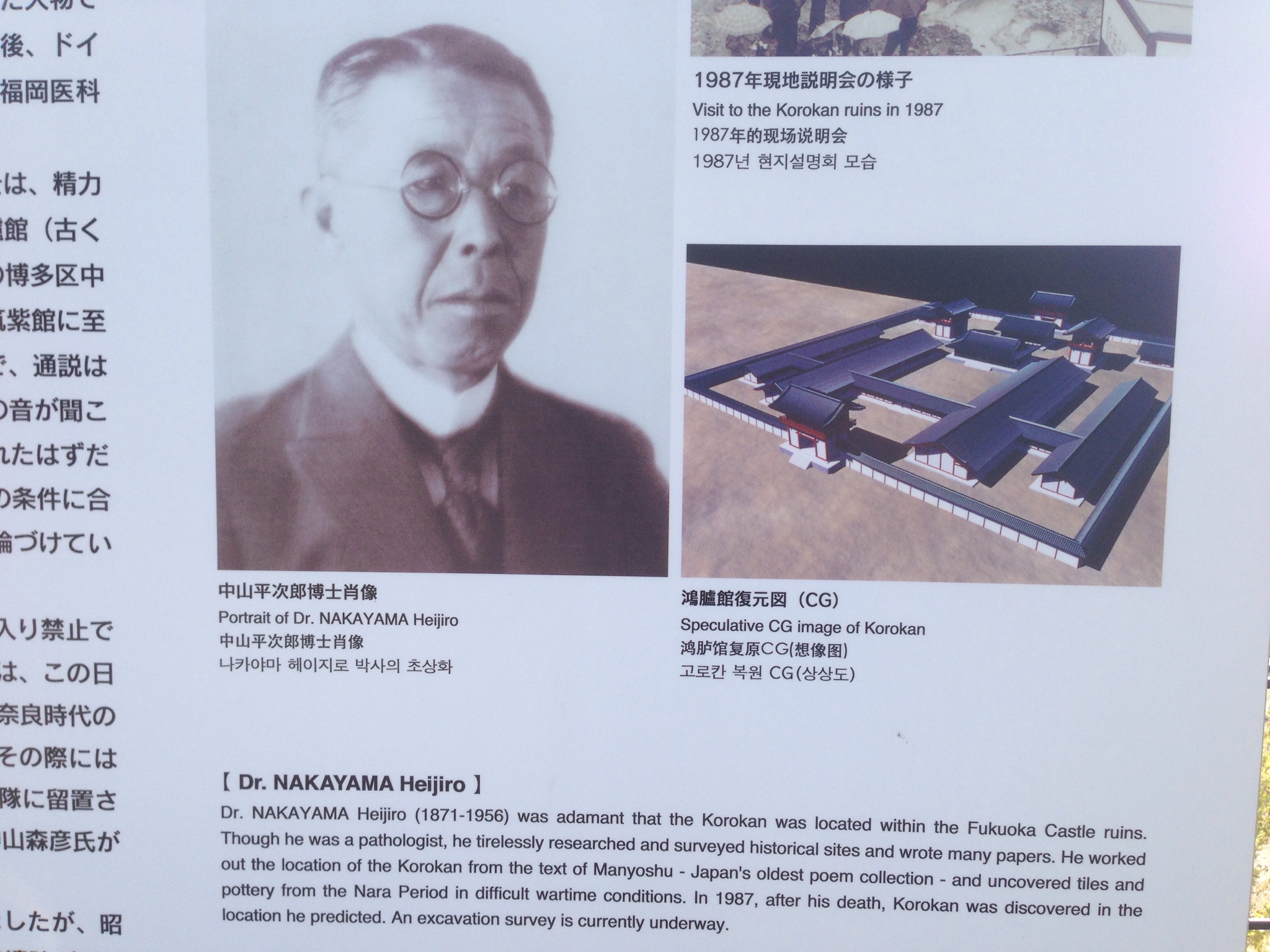
Ironically it was a pathologist, Dr Nakayama Heijiro, that theorised there was a Korokan here. Sadly he died in 1956 before his theory was proven.
Fokuoka is famous for its ramen noodles so I find a little place down near the harbour. Unfortunately there’s no English so I’m not sure if I got the special local version of ramen noodles or not.
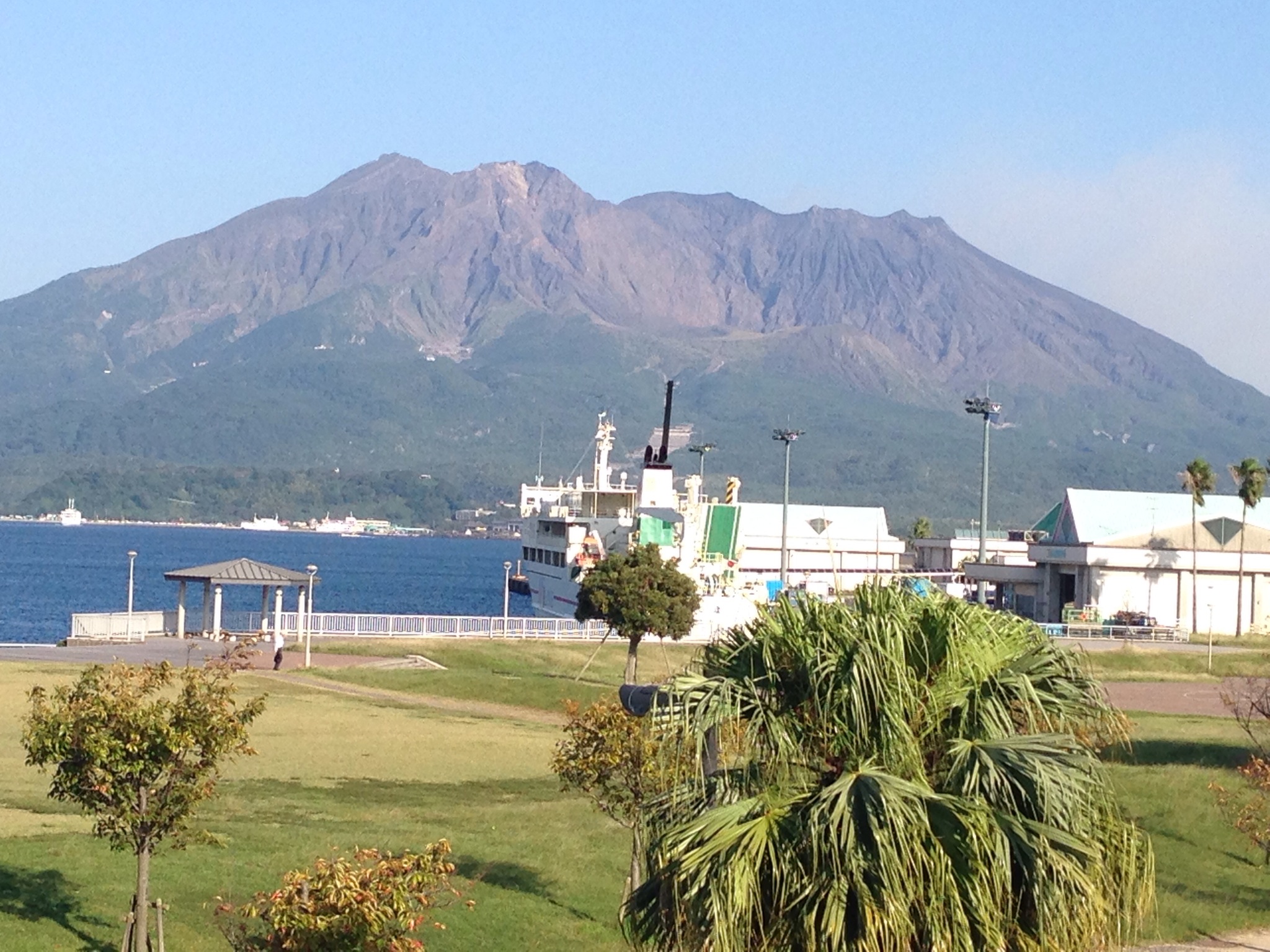
Visited Sakurajima today. Its part of Kagoshima but across the other side of Ginko Bay. You can drive right around or take a short ferry ride. There is an active volcano here that forms a spectacular backdrop to Kagoshima’s cityscape. The smoking crater has been active since the mid 1900s. A community is well established around the mountain and the ferries are busy taking people and vehicles to and from Sakurajima. I guess realestate would be cheap here but insurance costs would be high. There is some industry there as trucks loaded with something are constantly on the single road that circumnavigates the mountain.
It’s outside the tourist season so there are few foreigners about and the services are reduced. The bus system is hard to workout and English is sparing spoken or used in signage. I start with a short bus tour around a small part of the area. I’m hoping to get close to the smoking crater but that doesn’t happen sadly. There are many ensens here (hot spa baths) because of easy access to natural hot spring waters from the volcano. I follow a map to walk to one of these ensens. It appears close on the map but I walk for 8km. The naturally hot waters at this ensen come from 1000 meters below. For $3 I strip off and soak for a couple of hours in the heated pools and spas. People come to these places to relax tired muscles but also because they believe the mineralised waters have healing powers. These soaks really knock me out. At the end of it I feel too relaxed, unwanting to do anything after. There is a strict etiquette at ensens. Fortunately I have been shown by a local in Tokyo so I know what to do. You can’t have tattoos. Men with tattoos in Japan are seen to be associated with the mafia and are not welcome at public baths. This rule alone would discount more than half the male population in Australia. Fortunately I don’t have a problem. I try to catch a bus but they seem nonexistent. While at the bus stop a nice little old man pulls up and offers me a ride. He chats away constantly all the way back but I don’t have a clue what he is saying. I come across cement doorways in the side of the mountain. An information sign explains that there was a sophisticated naval base here completely underground. A diagram shows a maze of tunnels. I’m standing at the entrance to the ‘torpedo preparation room’ what ever that is. It’s all licked up unfortunately.
There is little more I want to do here so I head back to Kagoshima. My day pass on the trams is still active so to fill in the evening a jump aboard one and ride it to the end. There is a sign there saying this is the most southern team stop in Japan! Great, I can tick that one off. Curiously there is a metal statue of a koala.
I would have live to spend another day in Nagasaki but the hotel prices were rediculous. I find out why. There is a major highschool sporting event happening.
I board the bullet trains again and head for the southern-most point of Kyushu. Kagoshima is a sea port and has a population of over 600000 people. I arrive just after 3pm and easily find my hotel. I fill in the rest of the day jumping on the trams and having a look around.
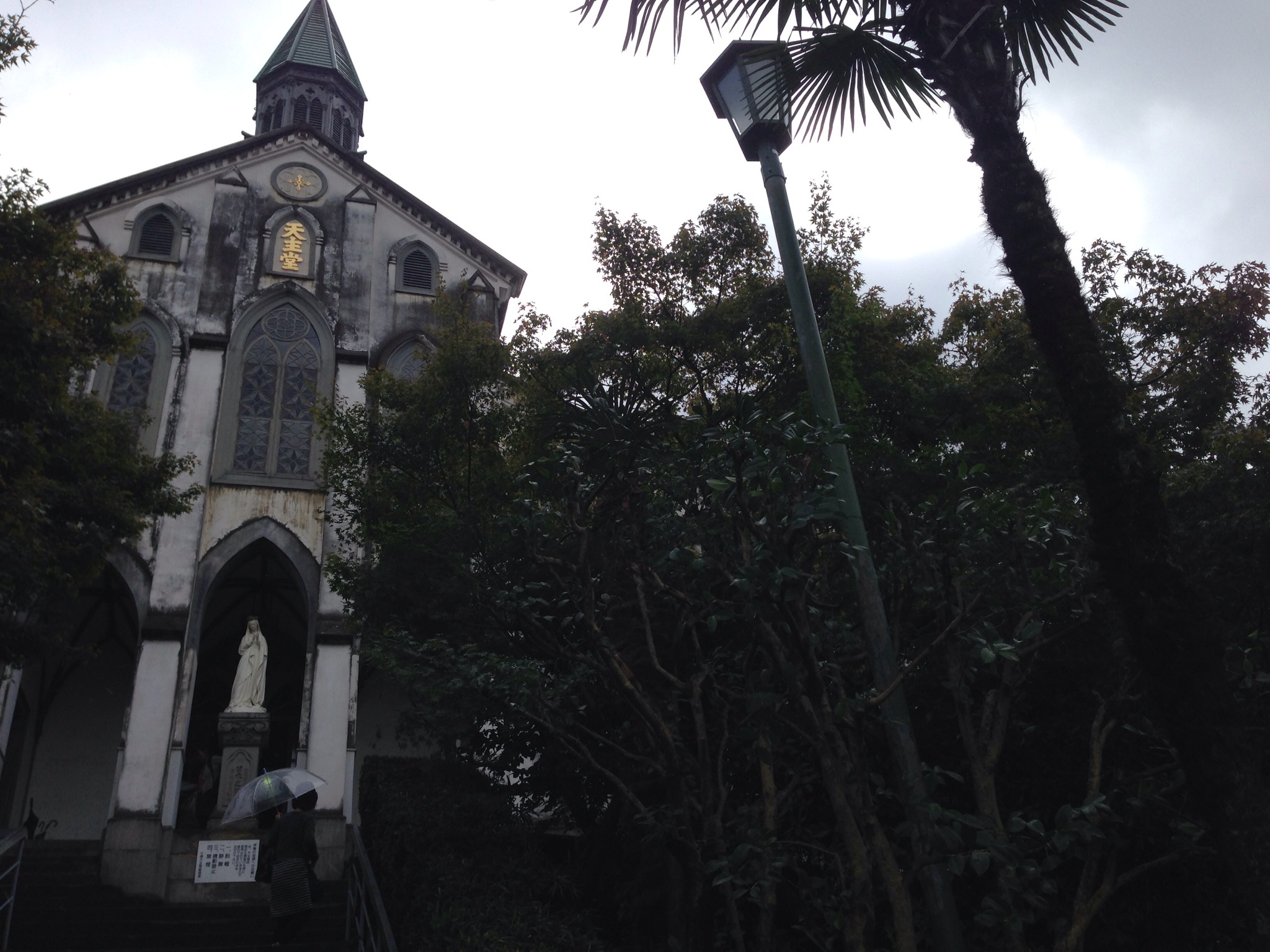
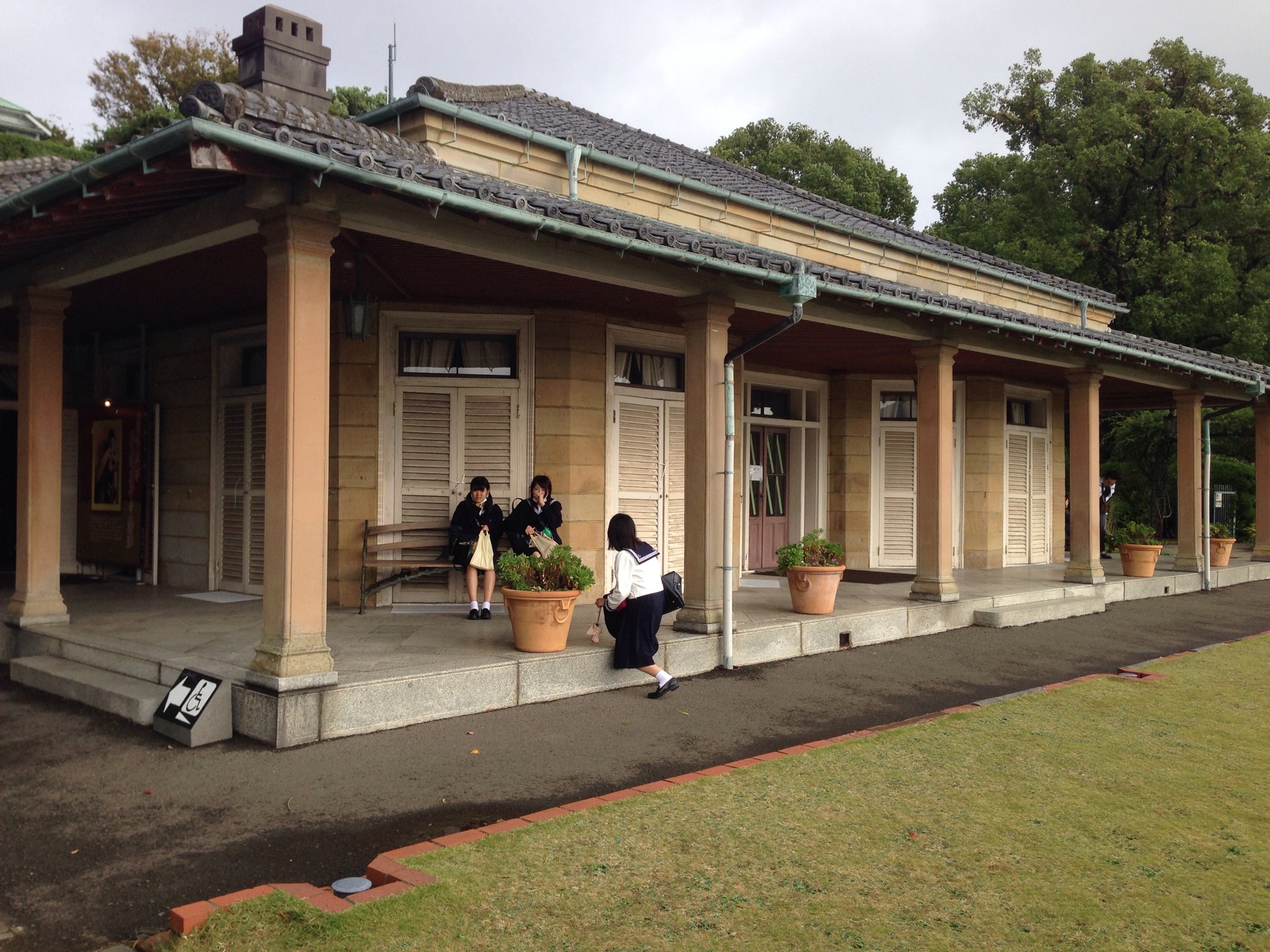
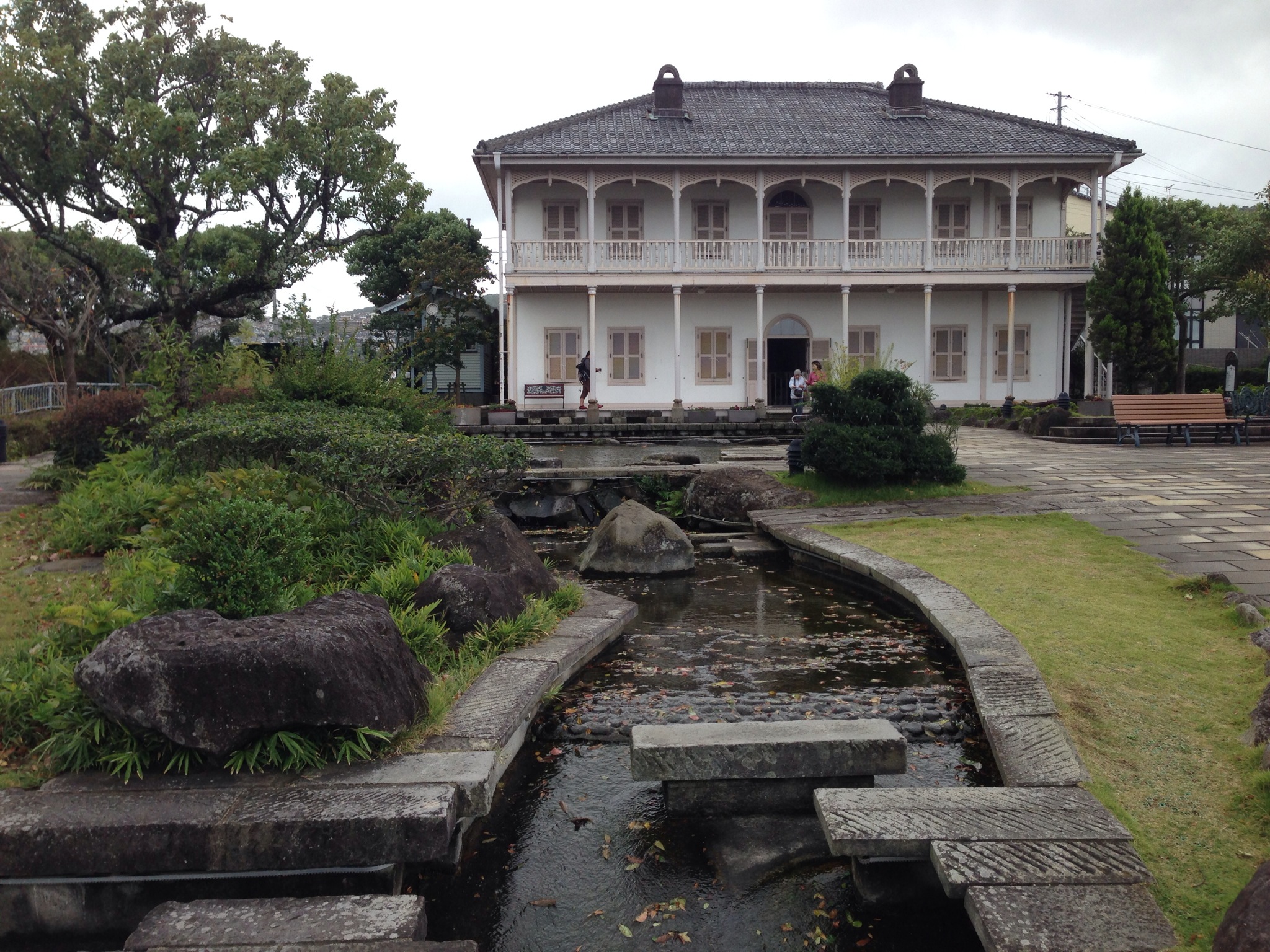
Oura Catholic Church was built in 1865 to commemorate the death of 26 Christians crucified in the streets by the ruling shogun. Amazing the church survived the atomic blast.Glover House where Robert Glover and his family lived for many yearsA garrison building I think, in Glover Garden, where visiting mariners were housed
Nagasaki is a unique city in Japan in many ways. It has experienced a very different history, with European influences immediately apparent in certain parts of the city. There are churches. Christianity was introduced by the Portuguese in the 16th century and despite the best efforts of the ruling shogunates of the time, still survive today. Christians were persecuted to the point of being publicly executed in the streets, but still they persisted. The Portuguese were expelled for their trouble but then the Dutch and English came to trade and develop industries. This was allowed by the rulers of this area, which was very unusual for isolationist Japan. There were limitations. All foreigners were restricted to Dejima island within the city. There is European styled architecture here and a beautiful old Catholic Church that has survived Nagasaki’s tumultuous past. This is Oura Catholic Church and it was built in 1865 to commemorate the death of 26 Christians crucified in the streets by the ruling Shogun, Toyotomi.
There is an area here called Glover Garden, where a Scotsman Robert Glover and his family lived for many years. Glover came via China in his mid twenties and was instrumental in introducing industry to Nagasaki. Ship building and railway construction were his thing, then later brewing. He helped set up a brewing company that is the parent of one of the big breweries today. Glover’s home, along with his associates, have all been preserved in an area called Glover’s Garden. It’s beautiful. Not far away is a beautiful Catholic Church. Walking around Glover’s Garden you can hear bagpipes coming through speakers, which is something you do t expect to hear in Japan.
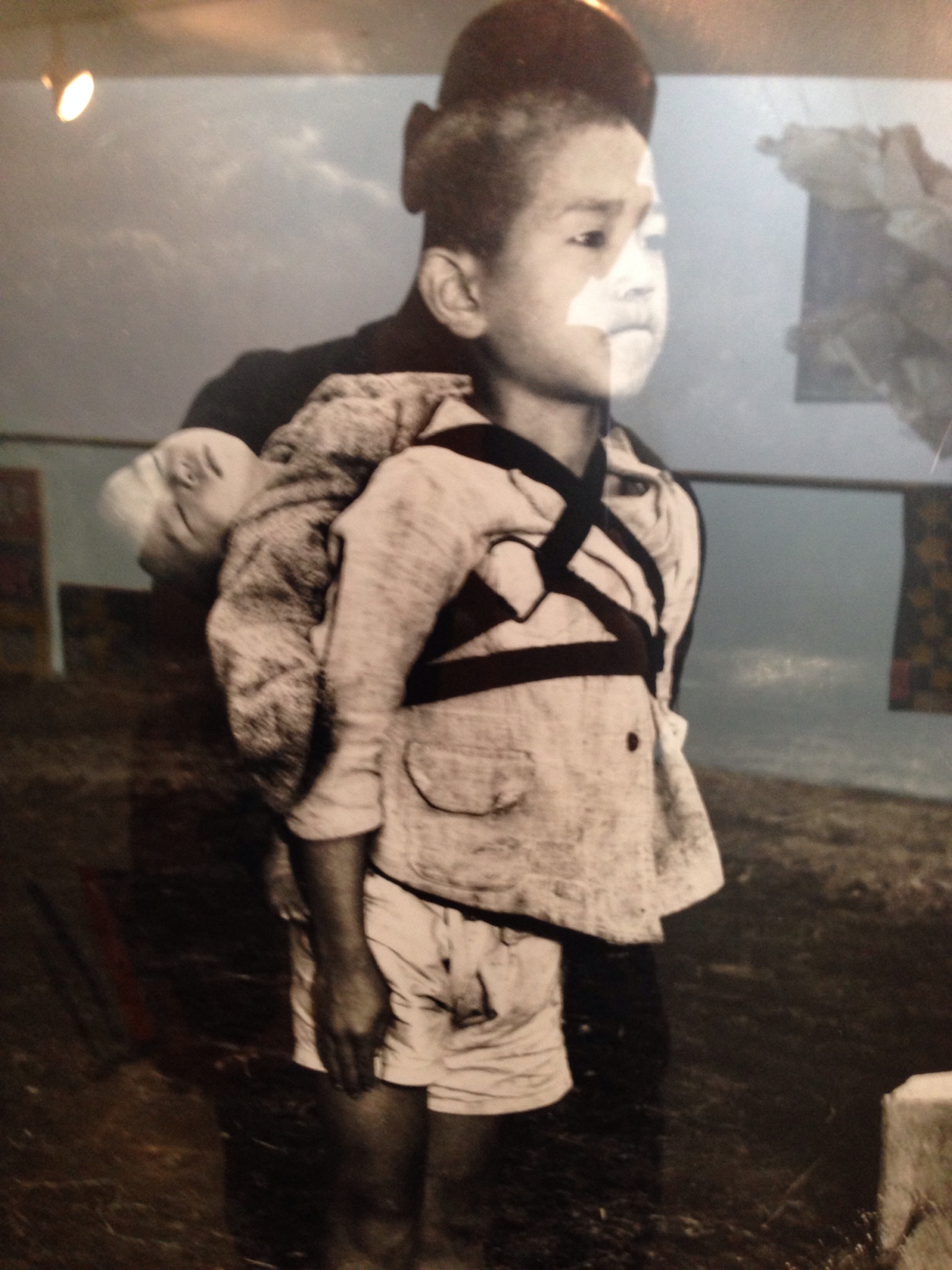
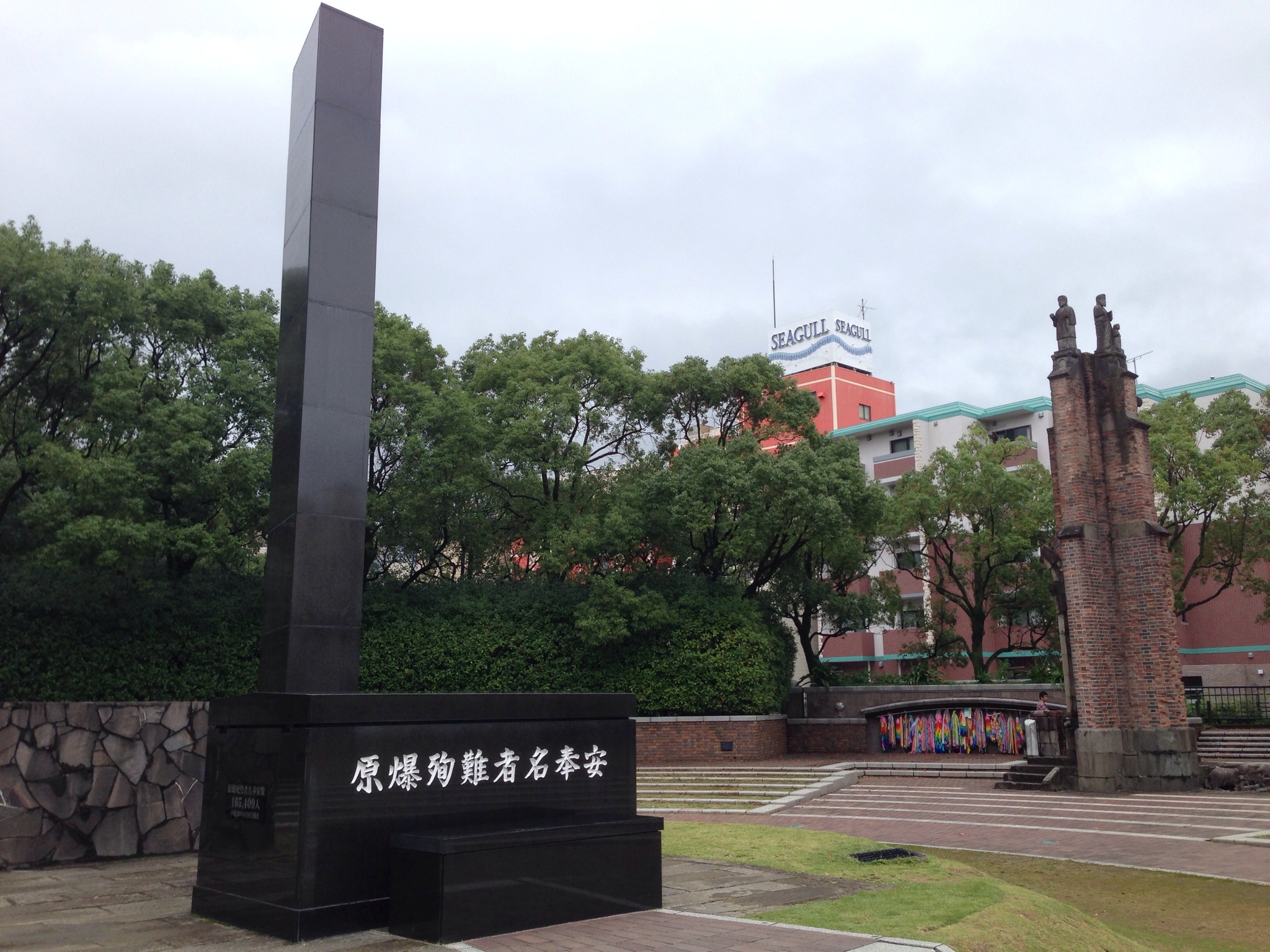
Like Hiroshima, they have a peace park here too. There is a marker showing exactly where the atomic bomb detonated 500m above. The museum tells the story most graphically. Some of the misery and horror of the time is on display. The photos and displays of children’s charred clothing tear at your heart, and for me, boil my blood. Damn the Americans for doing this to the most vulnerable of all, children and everyday people trying to survive in a war that was hard for them also. But of all of the sadness I witnessed throughout the museum, it wasn’t until I was on my way out and there on the wall I was knocked for six. On the wall was a photograph taken by an US Marine photographer, Joe O’Donnell, days after the blast and he records this tragic moment in time. A young boy has a baby strapped to his back. The boy is 5 or 6 years old and has come to a place where dead bodies are being cremated. The photographer goes on to explain that the boy stands there motionless. The attendants see the boy, approach and remove his dead baby brother from his back to cremate him. The boy then turns and walks away, his silent anguish showing itself in his blood-soaked bitten lips. To my mind, this is one of the world’s greatest humanitarian images of our time.
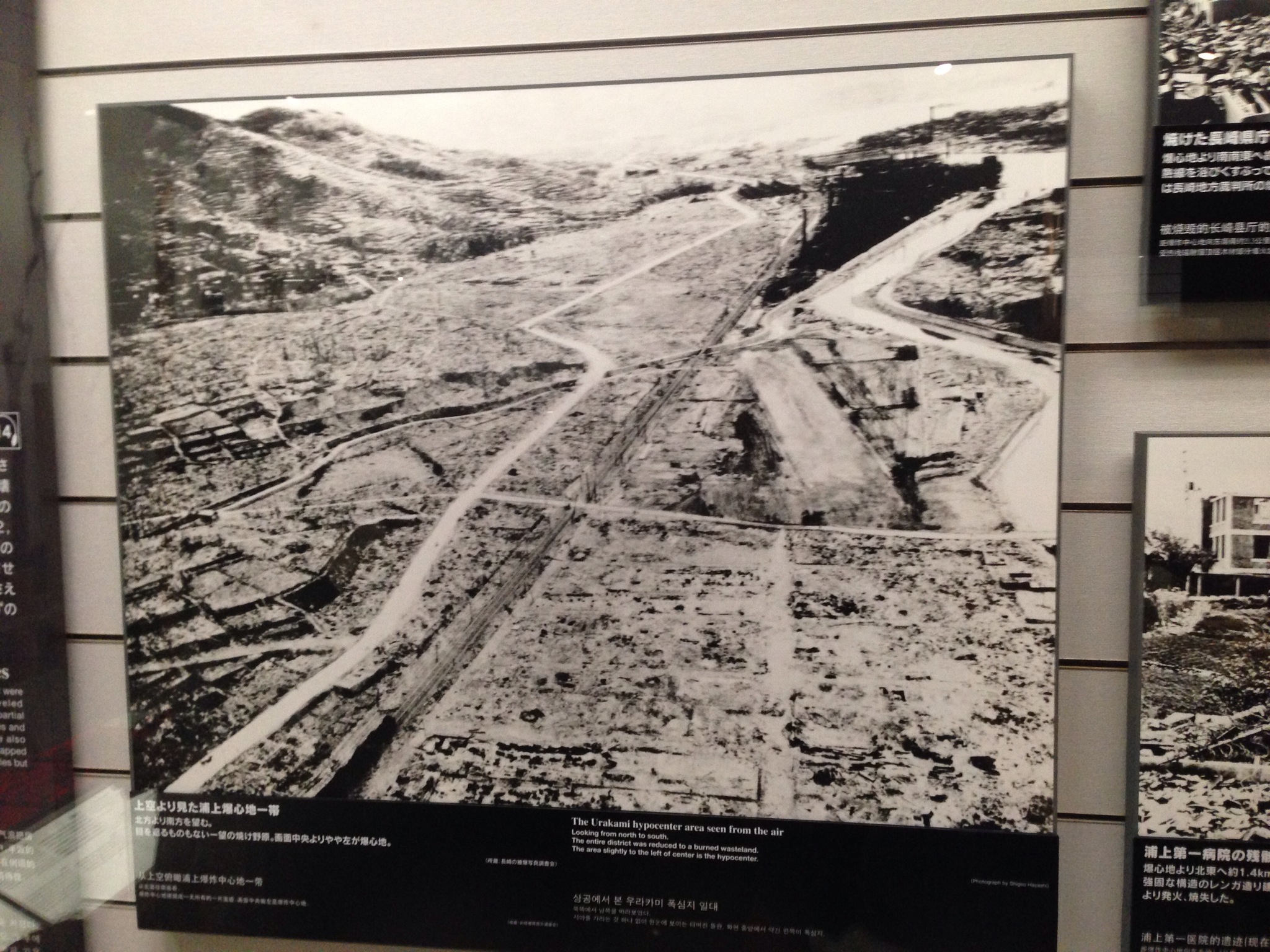
A picture of a flattened Nagasaki after the blastThe black spire makes where the atomic bomb detonated directly 500 meters above. Remnants of an old church destroyed by the blast have been placed nearby.
Here is the thing: It’s 1945 and Germany has already surrendered. Japan is on it’s knees and one atomic bomb has already devastated Hiroshima with unimaginable consequences. Russia breaks it’s treaty and declares war on Japan just two days later. Yet, the following day on 9 August, President Truman gives the order to release another atomic bomb on Japan. Nagasaki was not the first choice of target on that day but cloud and smoke interfered with the first choice. Nagasaki was hit just after 11am. With a population of around 240000, about 75000 were killed and around the same number were injured. Countless more no doubt died as a result over the coming weeks, months and years. President Truman says it was necessary “to save young American lives”. Some say it was to justify the billions of dollars spent on developing the atomic bomb in the Manhattan Project. I say “why is this not a war crime?” There was an option to use the bomb on a Japanese naval fleet. If you had to use it why not there? Both bombs caused unfathomable misery to the most innocent of participants in this ugly, sorry bit of history. Anyway, the Japanese have moved on where I clearly haven’t and now embrace the United States and all that it represents. But they haven’t forgotten. The moving museums and Peace Parks are testament to that. And the many school children that I’ve seen pass through these institutions suggest this history is an important part of the education curriculum.
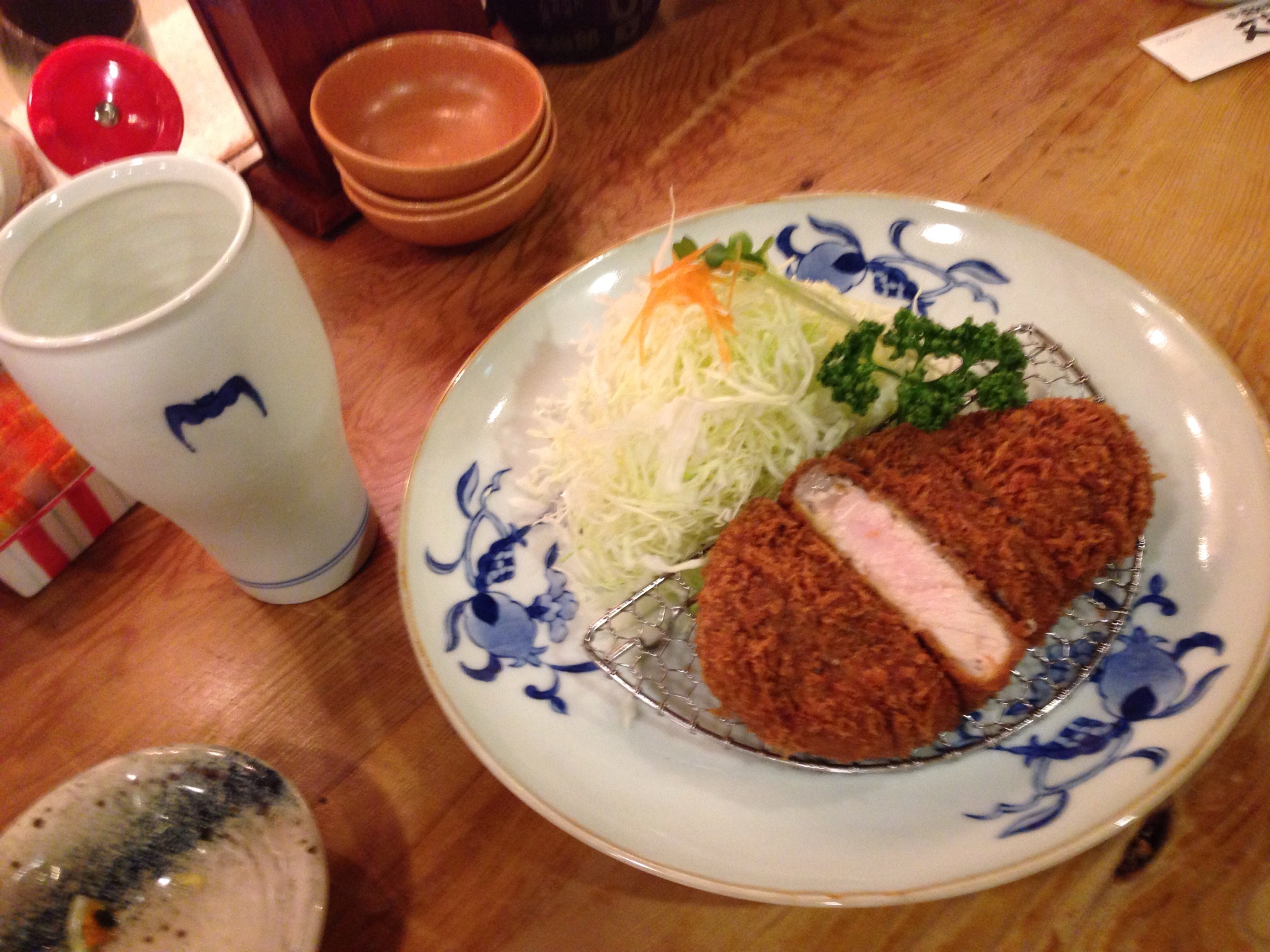
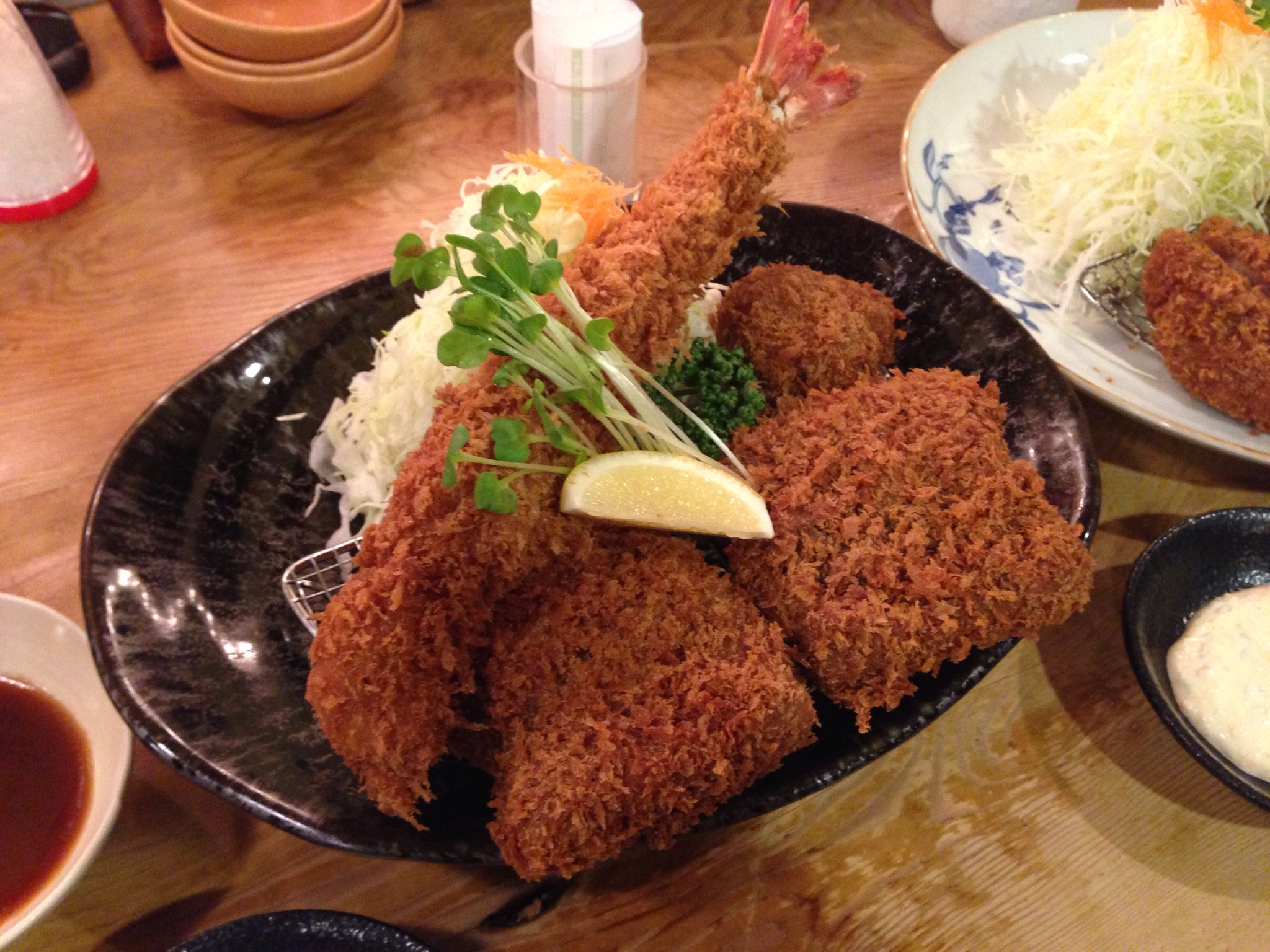
This dish is called Tonkatsu, which is crumbed pork with thinly diced cabbage, and miso soup and riceCrumbed deep sea shrimp, tuna and whale (small ball in top right of plate)
I meet Allan. He is a young native of the Carribean and has been teaching English in Japan for many years. He lives in Tokyo now but lived in Nagasaki for 5 years. He has returned to his old stomping ground for a friends wedding. We dine at his friend’s restaurant for dinner after a night stroll around his favourite parts of Nagasaki’s waterfront. It’s beautiful. While strolling around here the noise of clapping and cheering catches our attention. Like moths to a light we zone in on the noise to a sporting arena. Being far bolder than I, Allan takes us to the entrance and with adequate Japanese asks permission to enter. We’re welcome. Inside is badminton being played on many courts and competing are high schools from all over Japan. The local schools are up against competitors from outside and they are keen to win. The atmosphere is amazing. Badminton is a popular sport in Japan. I learn from Allan that Nagasaki is hosting a national high school sporting competition. This explains why I had problems finding affordable accommodation here. The local guy wins and all is good. Allan’s restaurant friend specialises in a Japanese dish called Tonkatsu, which is pork deep fried in crumbs with shredded cabbage, and rice and meso soup on the side. It’s delicious. The pork is so tasty and tender. With Tonkatsu the rice and meso soup are bottomless so topping up is included in the price. We are also dished up a plate with a large deep-water shrimp, tuna and whale in the same way. I felt naughty eating the whale and found it quite unremarkable. It tasted a lot like salty beef – hardly worth threatening a species over!
Today I move further south onto Kyushu Island to visit Nagasaki. Catch the bullet train to Hakata Where I change over to a normal train running at mortal speeds for the rest of the way. I was excited about crossing over to another island via the train but it happened without me even knowing. The islands must be linked or split by the narrowest waterways be a because I missed the experience completely. The train services are impressive. They run perfectly on time and frequently. You can choose anytime of the day to catch your train. The conductors enter the carriages with a bow and when exiting, they turn and bow again. Such respect, so Japanese.
I arrive in Nagasaki around 4pm and walk to my hotel. It’s overcast and windy because there is another typhoon approaching! Can’t believe I’m wandering into the path of another one just a week after the Tokyo experience. Lucky I guess. I go for a quick walk before dinner and bed. There is little English here and no English tv.
It’s just after 8 o’clock in the morning. You and your family are readying for another day. There’s a flash of intense light that catches everyone’s attention, followed by sound and wind. You are over a kilometer from detonation so you and your family survive the mysterious blast, but your house flies apart. You think you are lucky because you are still alive. There is instantly no power or water and eventually food becomes hard to come by, even impossible. But still you manage, despite seeing your neighbours starve to death. Months and even years later your children develop diseases that slowly debilitate them before your eyes. They die miserably slow deaths. Or if they survive, their children are born deformed. Perhaps now you don’t feel so lucky. Perhaps now you wish you and your family were instantly killed in the initial blast.
Then Hiroshima experienced a devastating typhoon the following month. A mud slide wiped out precious temples on nearby Miyajima Island. The people must have thought their faith had turned on them.
Prior to the atomic bomb dropping on Hiroshima, the city had been spared of any bombing. Apparently this was deliberate for some reason. Why it was chosen for this atomic attention is also unclear to me, although there was a military base here. The timing was extraordinary. Germany had already capitulated and Japan was on its knees but still, they dropped the bomb. And another three days later the US did it again. It’s hard to appreciate the sense of this. Yes I have heard the argument that this shortened the war and consequently save many lives. But what a price to pay.
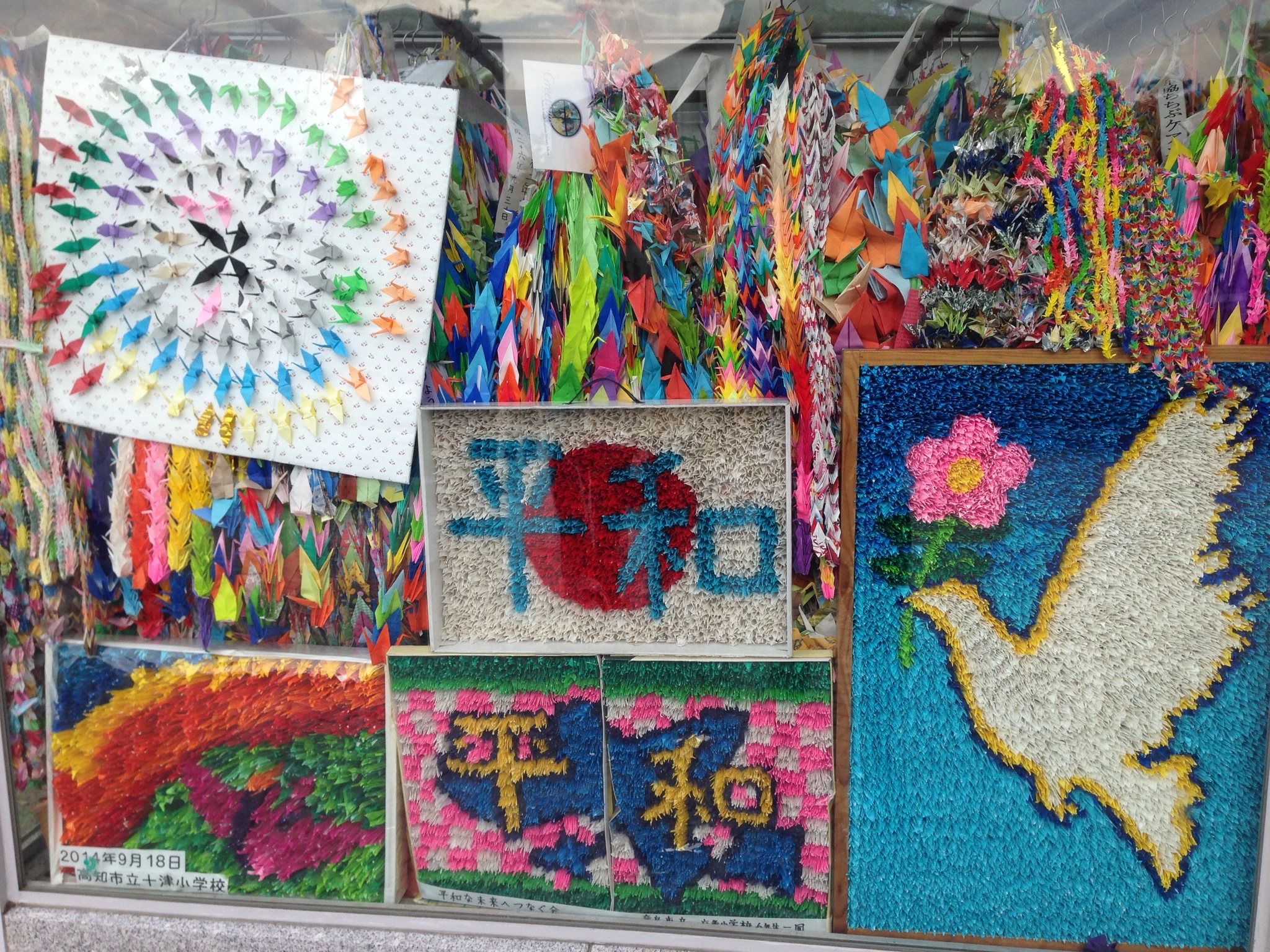
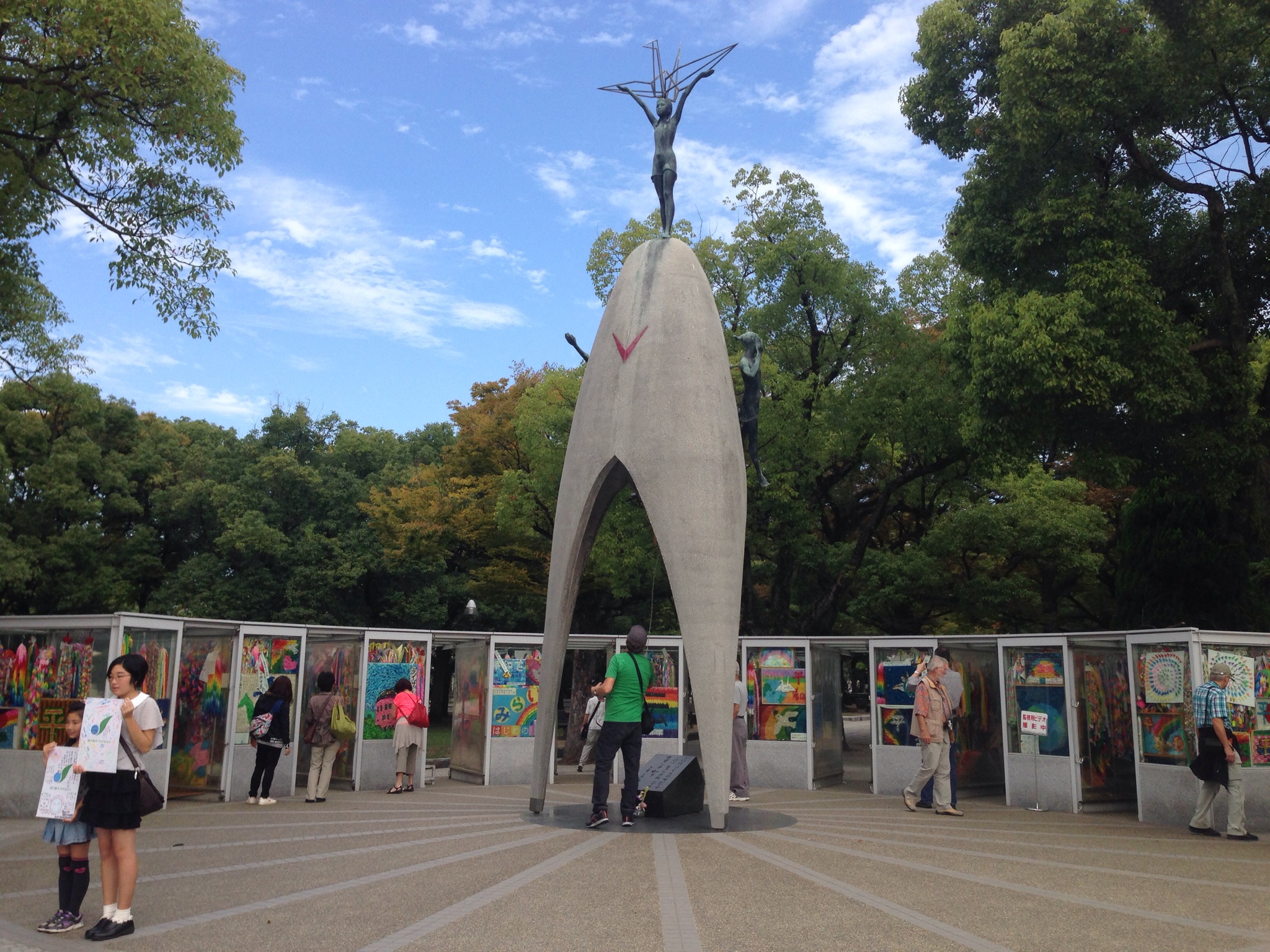
I visit the Peace park and museum this morning. It’s a beautiful treed park with many monuments relevant to that fateful day. The most moving for me was the Children’s Memorial. This memorial was the result of a movement inspired by the story of one of the victims. Sadako Sasaki was two years old on that day but survived, only to succumb to leukemia 10 years later. To help her deal with the misery of the disease and to encourage recovery, she made colourful paper cranes from her hospital bed – symbols of good luck. Her plight caught on world wide and paper cranes came in from all over. Thousands upon thousands of them are woven into long ribbons or pictures and feature here with this memorial and many others around the park.
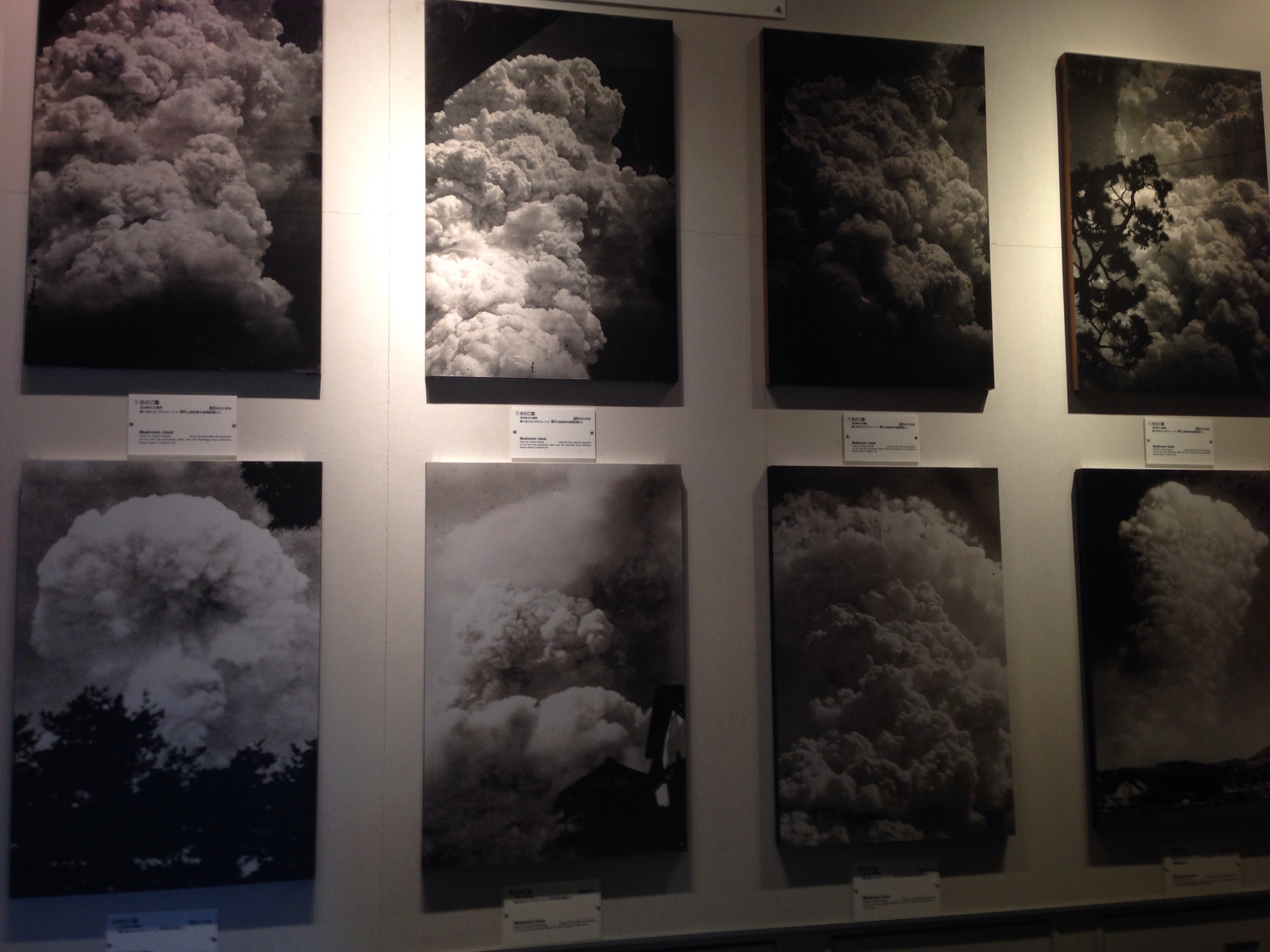
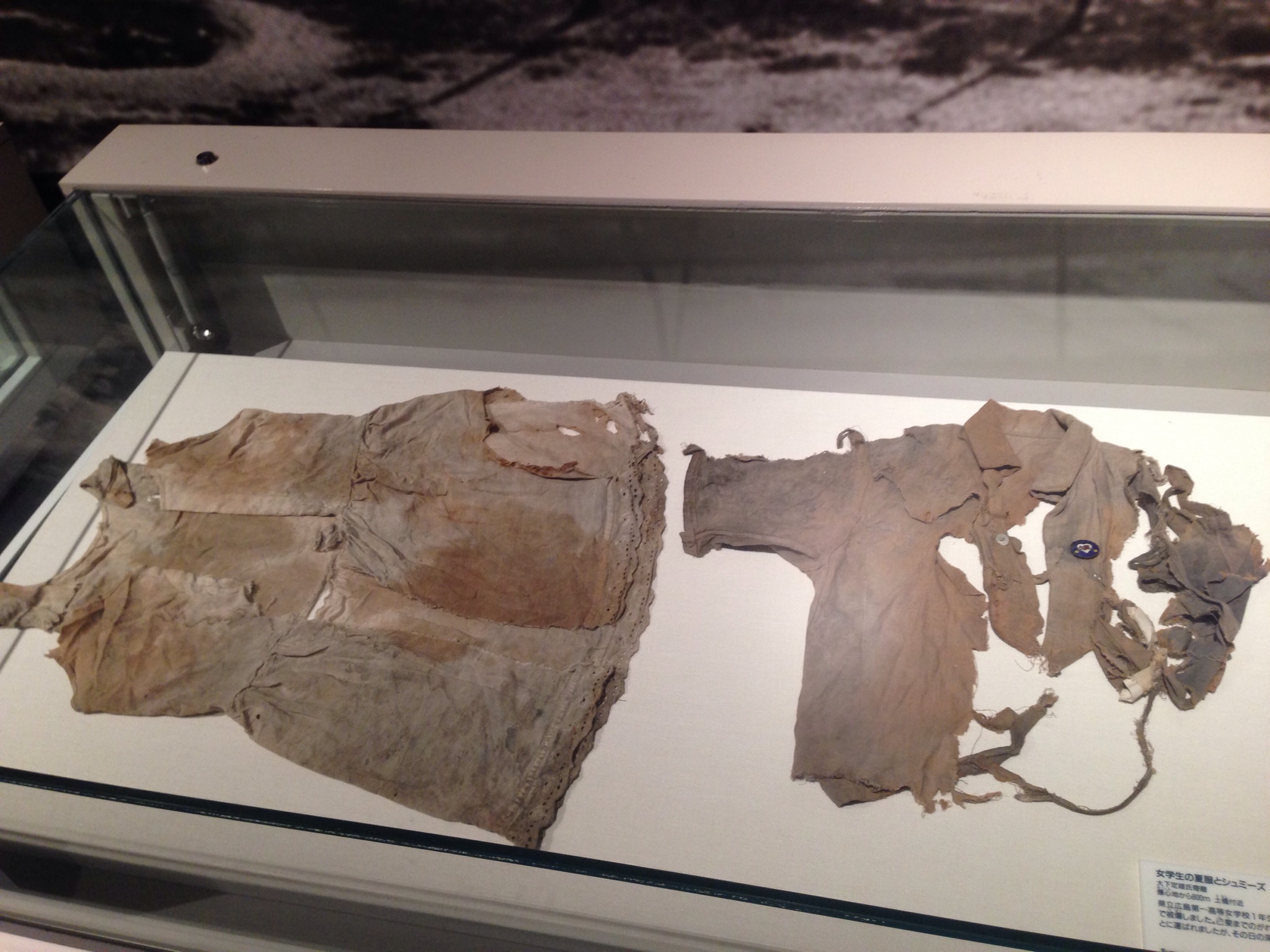
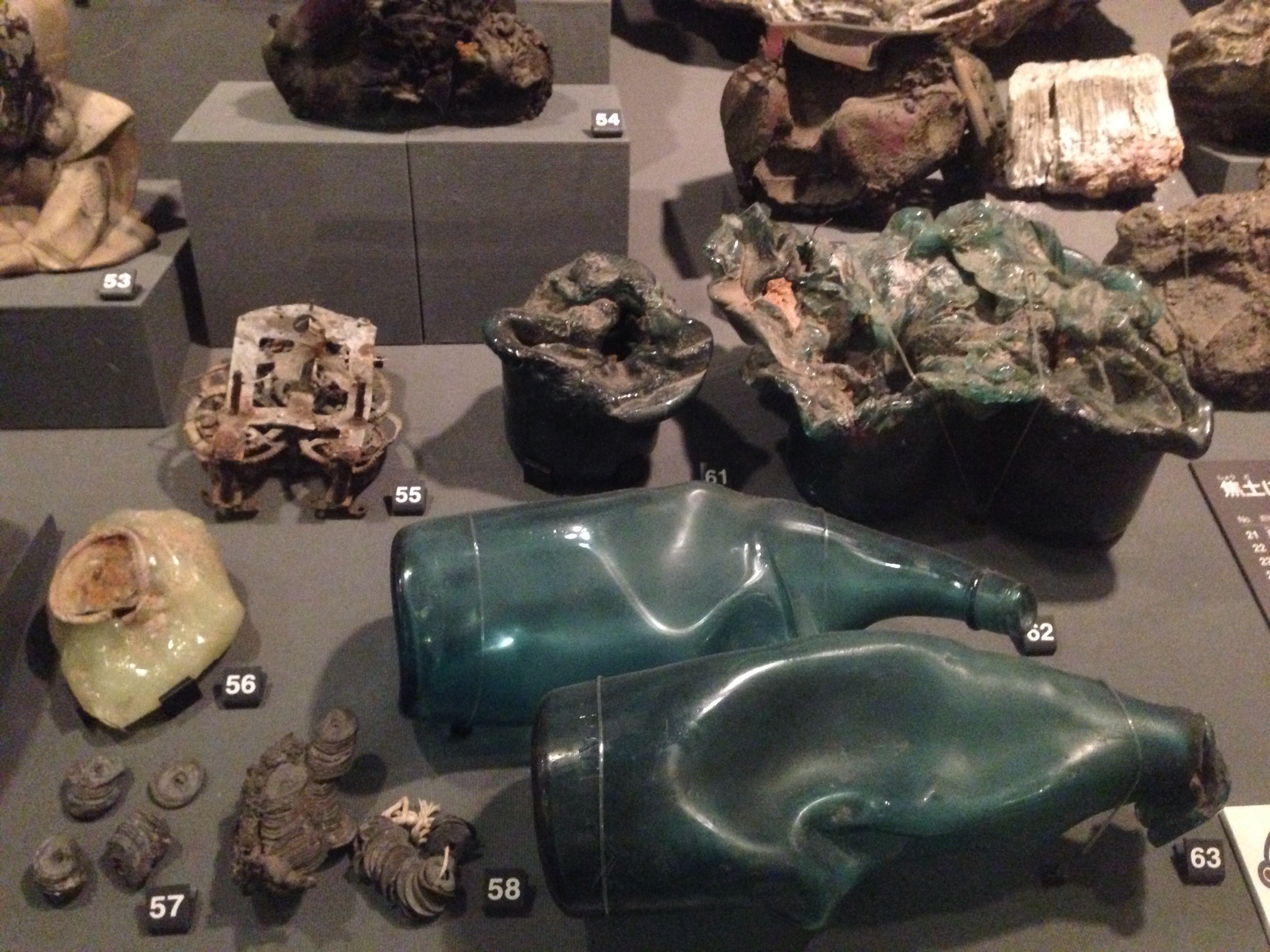
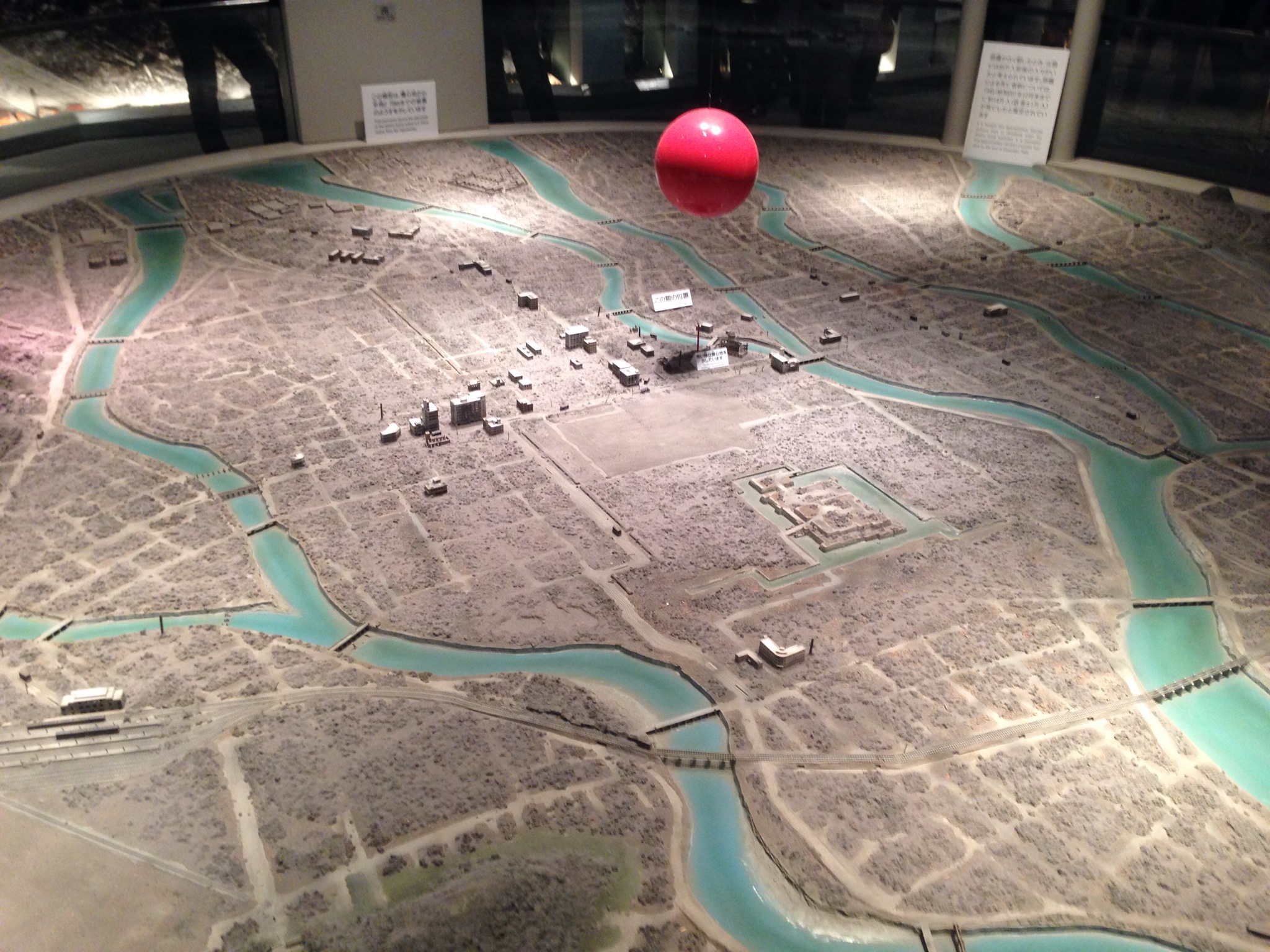
The museum here graphically paints personal hardships experienced by the most vulnerable and innocent, the children. Charred remains of their clothing and objects are just part of the misery on display here. Seventy to eighty thousand people died that day, then countless more over the coming months and years. Then the genetic damage from radiation poisoning later expressed itself through deformed offspring for generations. Then there are displays of twisted and melted things, photos of the mushroom cloud and explanations of the events during and after.
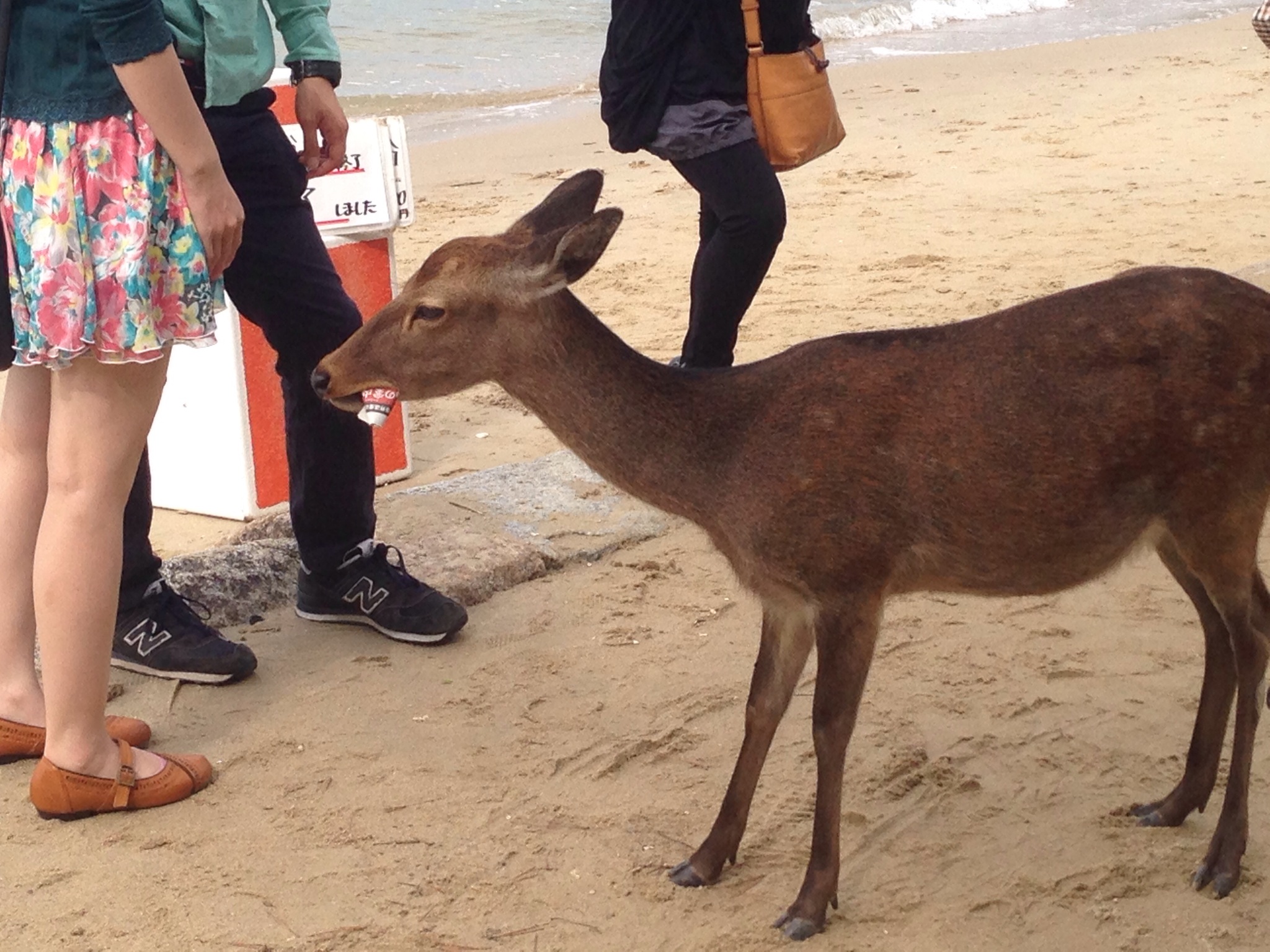
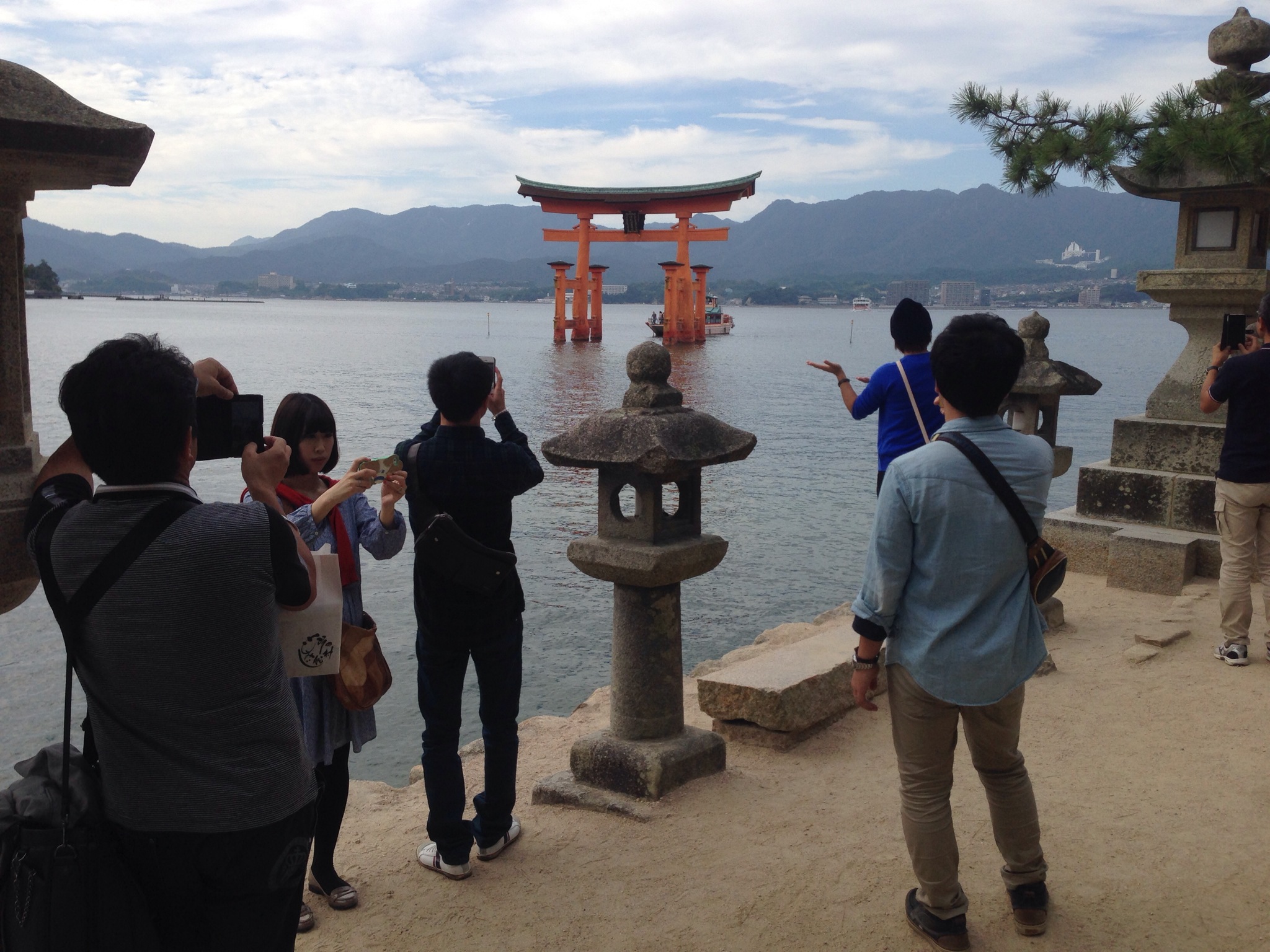
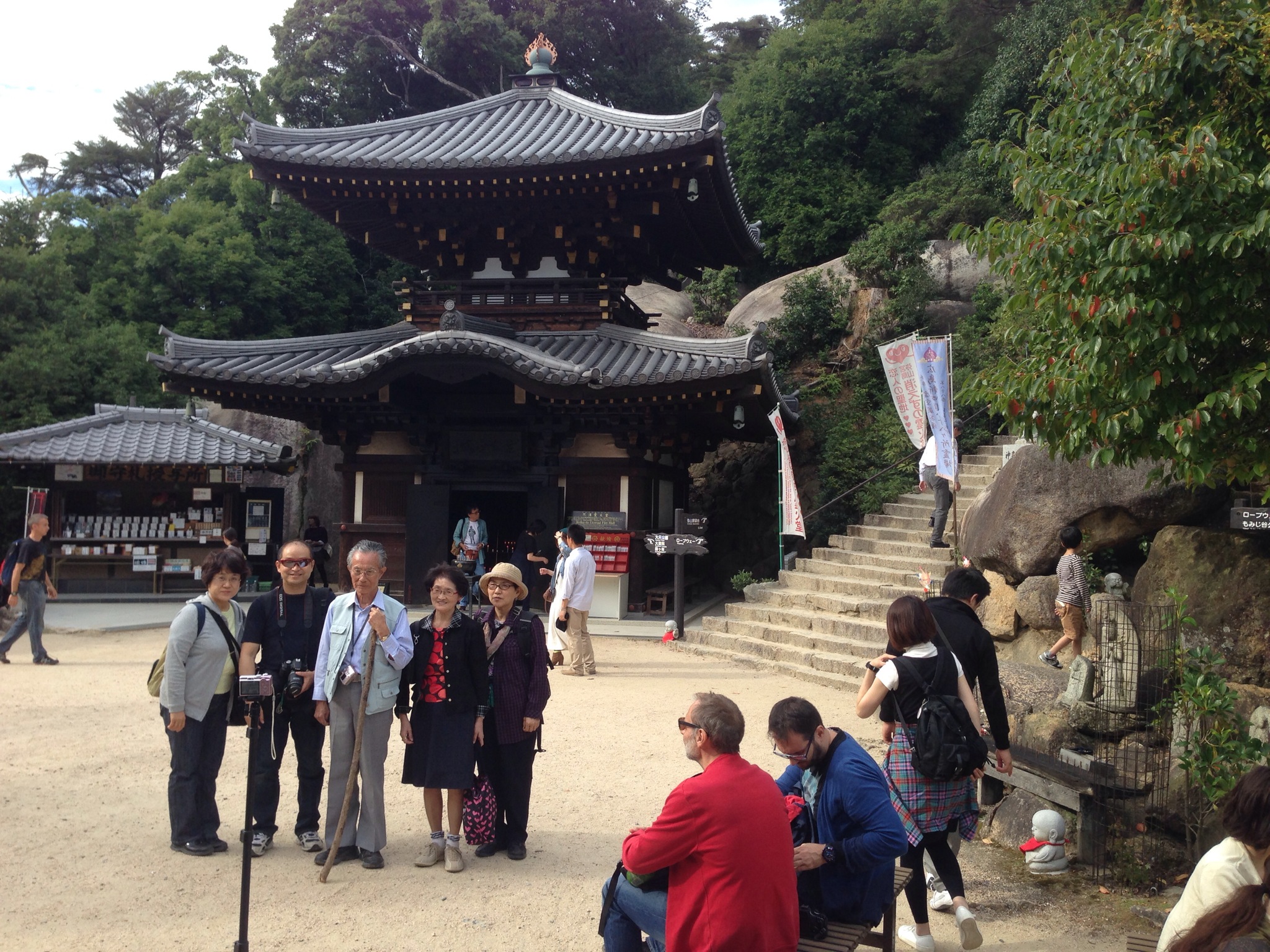
On a lighter side I visit Miyajima Island for the afternoon. It’s a big hilly island a short boat ride from central Hiroshima. It’s very popular with tourists from Japan and abroad. It’s busy today. It must be the spiritual heart of Hiroshima because there are beautiful temples and shrines all over. The grandest is Itsukushima Jinja located in a cove with its spectacular gate (or O-torii) out in the water. This gate is an iconic image for Hiroshima. It’s in all the brochures. Some temples are hard to access. I scrambled up a steep path to get to the the highest point of the island, 430m above sealevel, for great views and more temples. And for the tourists there are markets and food. To add character there are many Japanese in traditional dress and cheeky native deers. These deers are very curious. They roam the streets and lane ways, relaxed in the company of the many visitors to their island. They nudge you with their noses, pleading for treats with their cute little faces. They eat anything, including paper. I saw one reach into a ladies bag and pull out a multi-paged brochure, then eat it! Hilarious!
I finish the day over a few beers with a New Zealander I bumped into. He’s in Hiroshima with a rugby team. He’s been living in Japan for 12 years, initially playing club rugby and now coaching the team he used to play for. He played professional rugby with the Chiefs, a rugby franchise in New Zealand. He then continued his career in rugby mad Japan as so many players from around the world do. Rugby is alive and well in Japan and they are energetic in improving their standing in the world rankings. His team is a company team as they all are I think. They play tomorrow.
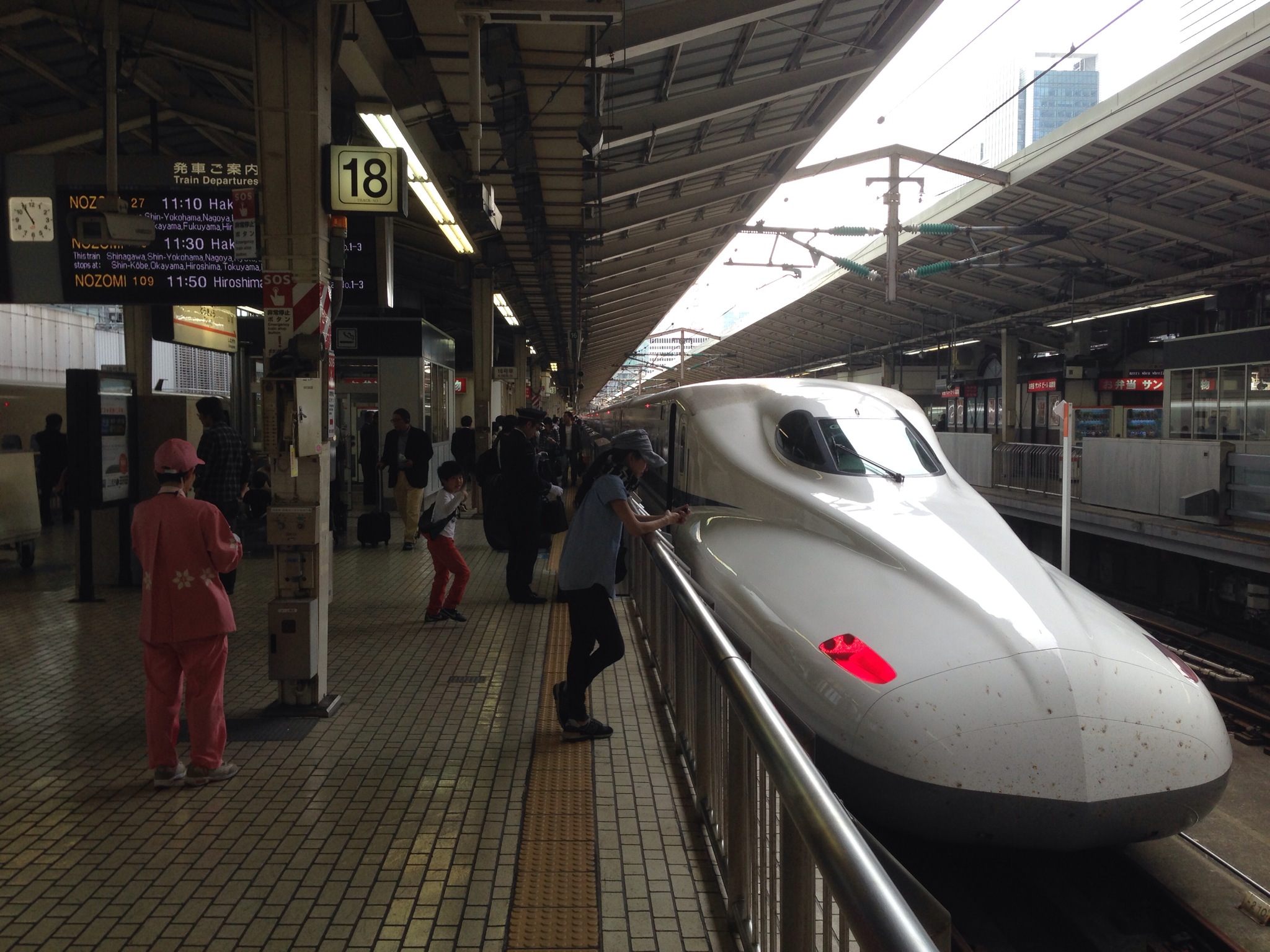
I’m excited today because I get to ride on a bullet train for the first time. I’m leaving g Tokyo for Hiroshima. With my pre-paid rail pass I simply reserve a seat on one of the many express trains that will go this way each day. Tokyo station is an experience in itself. It’s enormous. The volume of humanity that must pass through here daily is staggering. I did hear that in one of the stations here in Tokyo, maybe this one, an equivalent of the entire population of New Zealand passes through each day. I suspect that may include the NZ sheep population as well. Everyone seems to know where they are going, which clearly sets them apart from me.
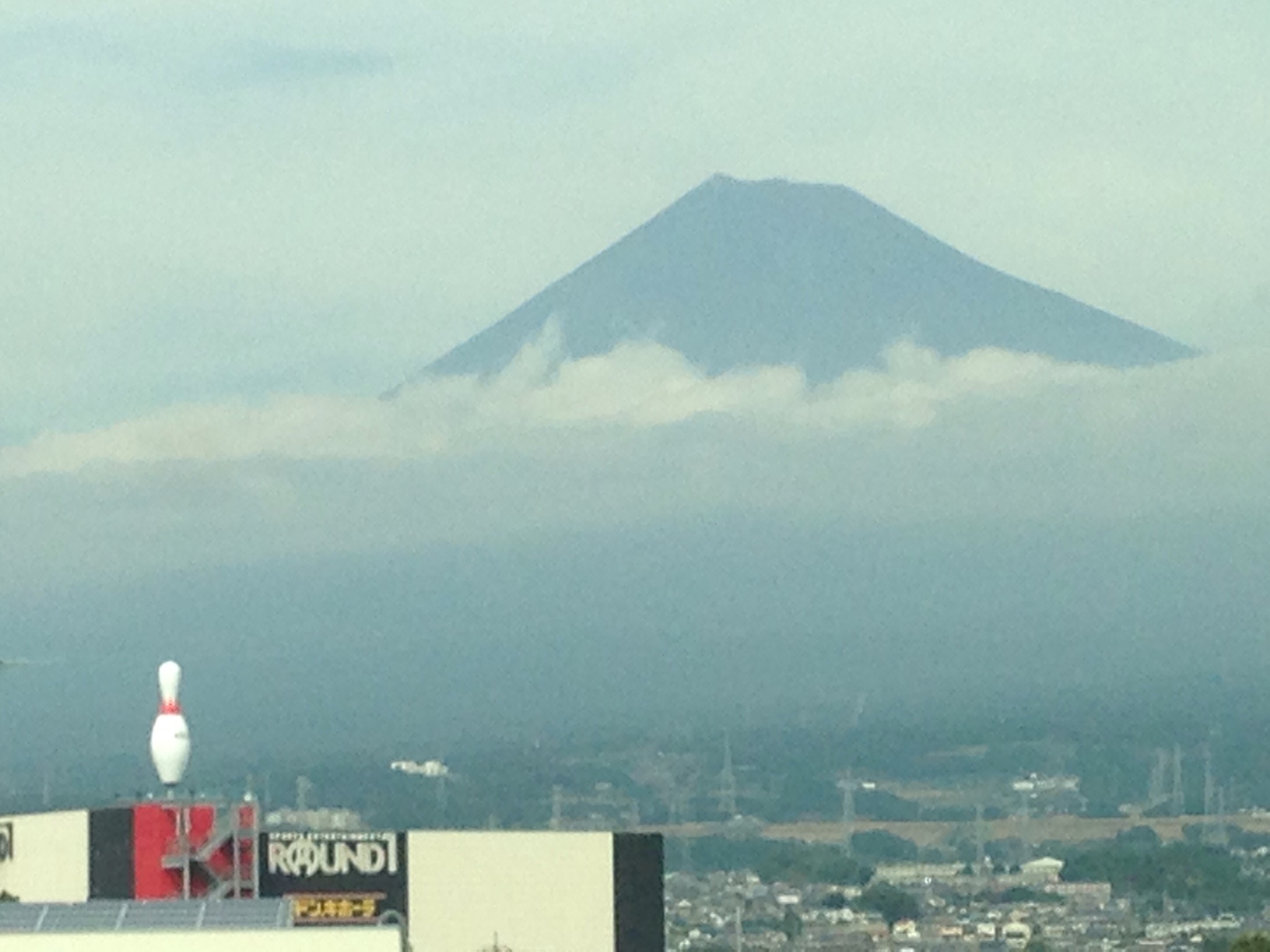
I find the right train with some help and away we go. Just awesome. They are built for speed these trains. They even look the part with their highly aerodynamic noses rivaling something out of a science fiction movie. Seating is spacious and the ride is as smooth as an aero plane. We follow the coastline. The scenery ribbons past at great speed. Between Tokyo and Osaka the track is lined with dense living the whole way, with some industry and rice fields finding any space it can. Mount Fuji dominates the landscape to the west. Between Osaka and Hiroshima the houses thin making way for picturesque patches of rice fields. They illuminate in the light of late afternoon.
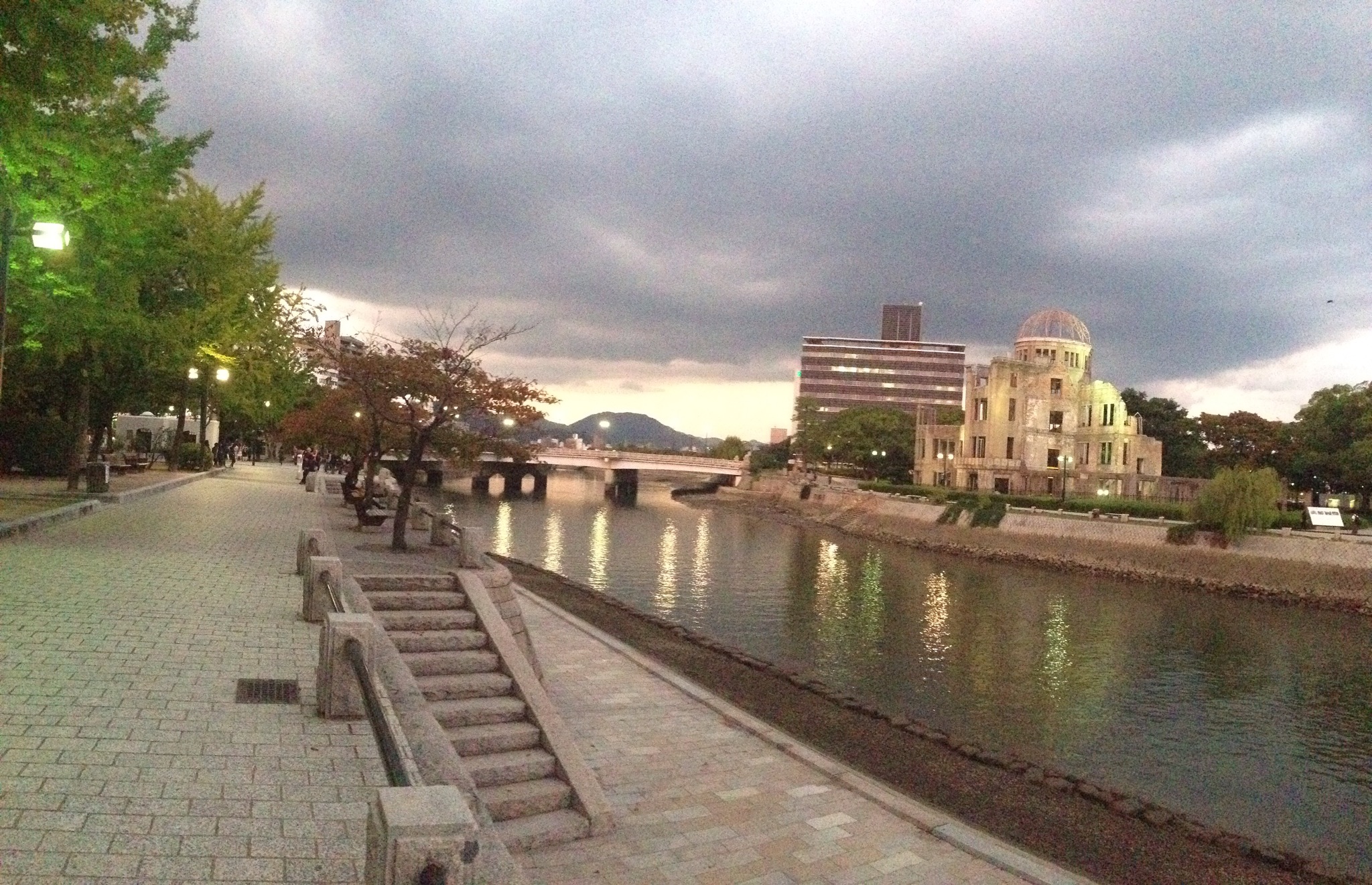
I arrive in Hiroshima at 4.30pm and get to my hotel easily. It’s attached to the railway station. I want to try and get some photos in the setting sun so find a bus and rush to the Peace Park. Unfortunately I miss the sun so I take a stroll through the park to the Atomic Bomb Dome. The city was obliterated in 9 August 1945 when the Americans detonated an atomic bomb 600 meters above the city during WW2. The elevated detonation would ensure maximum impact. And so it did. There is one building that resisted the impact when all others largely failed. All inside were incinerated as were 70-80 thousand other residents of the city. The bridge I’m standing on was actually the target the US pilots were aiming for. The Atomic Bomb Dome is now Heritage Listed and a symbol of anti nuclear weaponary.
 angusmccoll