Saturday 9 March 2019

Manado is a big city on the northern tip of Sulawesi. It’s a busy port and business centre but banarkin island just out from the city does lure some foreigners for its diving and snorkeling opportunities. There are some nice reefs here. My local friend knows of a better place for viewing the corals and fish of this part of the world.

It’s an early start. I’m greeted at the hotel by our driver for the day. Then we pick up my friend Ali and make way for his little known location. It’s just across the other side of the narrow finger-like peninsula from Manado but it takes hours to travel because the roads are narrow and the landscape mountainous.

It’s a small Muslim fishing village. Fishing is it’s heartbeat but changes are afoot. They’re now realizing their waters have potential for something more than catching fish. Tourism. Foreigners are discovering the reefs here and all they have to offer. A French man has built 3 houses on one of the islands and he is luring foreigners.

Ali’s organised a boat and for the next few hours we explore the underwater life off the coast here. It’s impressive. The colour and variety of corals and fish is easily the equivalent of what I can remember of the Great Barrier Reef. And there are little ‘petit’ reef sharks. This area has many apparently. I saw one in the distance. The other guys saw more. Of all of the wonder under the water, it was something I saw while walking up a small island peak. There’s a few trees making home for some birds. There’s a flash of brilliance and I recognize this bird. It’s a kingfisher. It looks like our azure kingfisher. What a treat.

It’s back to the village for lunch then back to Monado. Weekends on the roads through the villages can be unpredictable. Main thoroughfares can be closed for weddings or funerals, forcing traffic into slow narrow side streets. We’re redirected many times. Then the traffic closer to manado thickens to a standstill. Short distances take hours. I get back to the hotel around 6:45pm. What a spectacular day.
Friday 8 March 2019

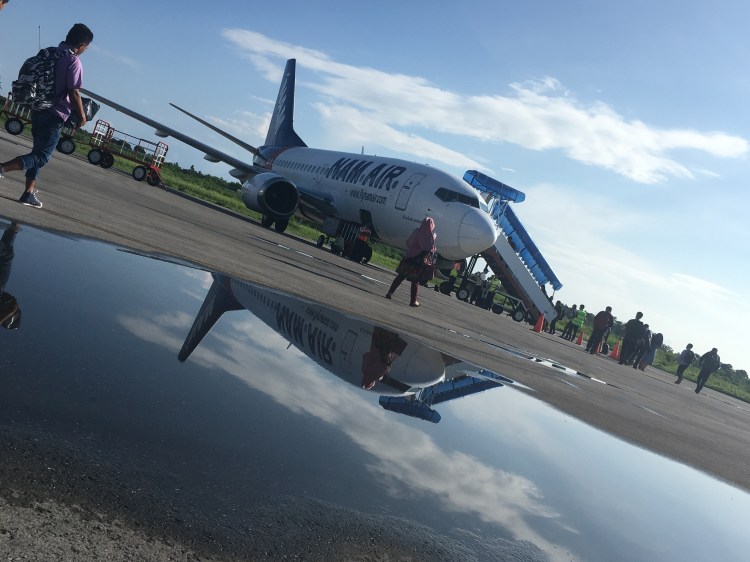
I’m up early, packed, early breakfast then a lift to the airport by the hotel. It was part of the deal. My first flight to Denpasar on Wings Air goes well and it’s a 3-hour wait for my next flight to Manado.

It seats 180 people but there are only 25 of us.

My flight from Bali to Manado on Sulawesi is with Lion Air on a Boeing 737-8Max. Does that sound familiar? It should because both the airline and the aero plane were all over the news a few months ago. The brand new plane flew into the ocean off Java killing all aboard and the plane’s electronics are one of suspected causes, along with pilot inexperience.

Why so few on this flight? Manado is a big city and a popular destination for Indonesians and some foreigners. It can’t be the reason. Could it be that people are untrusting of this particular make of plane?

Anyway…you’re only reading about this because I have landed and able to tell the tale.

I get to my hotel finally at 5.30pm. Manado looks very familiar to me know. This is my third time to this city. And the traffic hasn’t improved. At times this city is just clogged.

Thursday 7 March 2019

Not a good day. I have to be in Labuan Bajo on Friday to catch two flights to Manado so I decide to fly from Ende rather than risk buses. It was a process just buying the ticket then mid flight we’re redirected to Lombok because of bad weather. Waited in the Lombok airport for hours before reboarding the plane for Labuan Bajo.

I prebooked a hotel in Labuan Bajo. I had difficulty finding it but finally booked in and crashed. I’m tired. Then the sound of angle grinders! It’s a construction site as the hotel is in the process of expanding. Bugger. I pack up and leave, with full refund of course. There’s no WiFi so I can’t search for another place so I walk, in the rain, for kilometers. People offered rides but I turn them down. I cold call into a hotel I found on MapsMe, Kasawuri. I’m really exhausted now, and wet. And on top of that, fluey.

Saturday 2nd March 2019

I read about Paga on Flores and the opportunities to experience nice beaches from the Lonely Plants guide so rather than spend a night in the airport town of Maumere, I caught a mini bus from town directly from my flight for Koka Beach. My rogue of a taxi driver from the airport to the bus recommended staying at Cowboy Ricky’s place near Paga. I nervously went with it. After a hairy ride in an overpacked mini bus with bald wire-exposed tyres in the pouring rain over a windy mountainous road, they dropped me off without directions! I found signs. Quaint little bungalows are what I first see, then Cowboy Ricky. He’s a local but obviously a stand out character. Shirtless and bejeweled in all sorts of regalia he introduces himself and shows me around. Facilities are truly basic. Open bucket showers and toilets and an open kitchen if you want to cook your own stuff.

Right away I want to visit the beach which is 2km away. A bungalow owner on the beach picks me up and gives the hard sell about his place. It looks very nice and right on the beach. Anyway I’ve committed to Ricky’s for tonight.

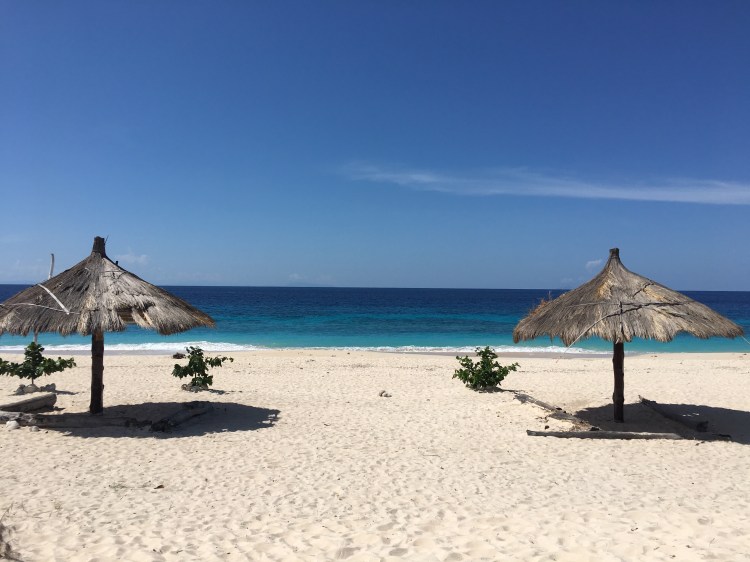
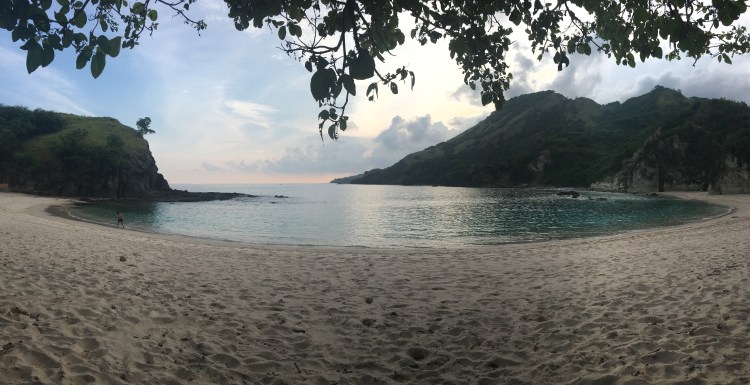
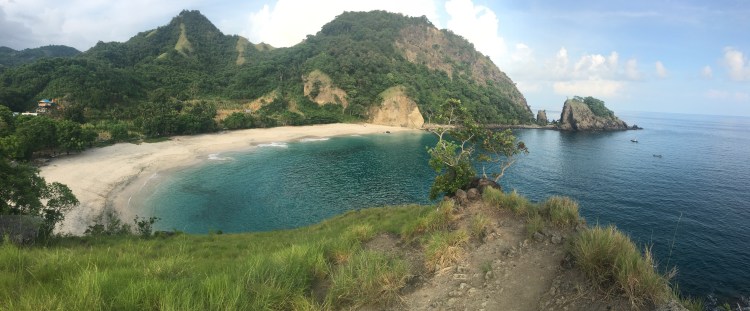
Wow, it’s beautiful. White sandy coves find space in a rocky coastline. Fishermen fix their nets. I walk to the top of a knoll for views. It really is pretty and will become a tourist lure. I’m located between Maumere and a place called Moni, where tourists go to experience famous crater lakes of multi colours. With a bintang in hand after a walk around I’m approached by Joseph, a young local man collecting shells on the beach. He stops to practice his English. He’s come home after working in other parts of Indonesia to be closer to his ailing mother. And because he suffered some illness. He’s father and brother have passed away from illness. He’s English is good, he says from school and an effort to engage with tourists. He’s catholic as are a large majority of the population on Flores island. He’s a beautiful personality and easy to engage with. He wants to make jewelry with his shells to sell to the tourists but he also wants to become a guide and is waiting for a certificate from the government. He offers me a lift back up the bumpy road to Ricky’s. I offer to pay but he refuses, which is extraordinarily refreshing and genuine when travelling. I like him a lot.

I’m s but out of the town of Paga but Ricky points me in the direction of A local warung (or restaurant). It’s a small family place and the food is awesome. My second meal of you day.

I was very unsure of how this day would turn out, from my flight with Wings Air with their reputation for cancelling flights, to my plan of avoiding Mauree by bus to Paga. I’m very happy so far. Can I stay another night? I really want to.

Sunday 3 March 2019

Koka Beach is even more beautiful in the morning light. I walk down there first thing with no real agenda apart from getting some photos. It’s hot and steamy already so I take a swim. The water is crystal clear and I have the beaches to myself for a while. Fishermen start coming in and with them their catch.

Some ladies have just open up their stalls so it’s deep-fried banana and coffees for me. Very relaxing.

It’s Sunday, church day and the only school-free day for the kids. Once church has finished the locals come down to the beach for fun. Kids come down in boisterous mini-packs or if they’re on bikes they come freewheeling at speed down the last stretch of bitumen road. It’s a satisfying morning observing the locals on their Sunday morning. The beach is popular with people from the cities too. They come in their cars. The fishermen get to sell their fish fresh from the ocean.

It’s a shower and short rest before Andi arrives and offers to take me up into the mountains to his village. It’s high up and a struggle for his little bike. Andi teaches sport at his local elementary school. He gets paid the equivalent of $10 per three months! Unbelievable. They teach six days per week with just Sunday off so he finds tourists to take to his village for extra cash. His cousin (he describes her as his sister) is a physics teacher at mid-school and she gets paid the same. Andi takes me around his village to meet his extended family and introduces me to his culture. They are farmers here tending gardens of corn and other things on the sides of steep mountain slopes. There are children of all ages everywhere and I’m a bit of a novelty despite the number of tourists Andi has brought up here. I feel so intrusive taking photos but Andi encourages me to do so. Most oblige but some don’t, which is fine. I explain to Andi if I was them I wouldn’t want my photo taken either. He explains that Indonesians are jealous of our noses and our skin! Wow. I’m jealous of their looks and their skin. How crazy.

People of Flores bury their deceased family in crypts next to the houses. Some of the crypts date hundreds of years Andi says. There are many small graves for children dying very young. These crypts are part of the family furniture. Children play on them, elders sit and chat. It’s like the dead are still part of family life. I explain to Andi how we treat the dead in Australia, some cremated and some buried. He’s in a family of three but his two older sisters have died already from sickness. He doesn’t know what the sickness was. He invites me to his home for coffee, made by his cousin. Country and western music is blaring. They prefer Western music to Indonesian for a reason I don’t understand.

The views from his village are spectacular. We’re up about 1000m I’m guessing and it’s cool and clear. Thunderstorms fill the background.

Back at my bungalow Ricky tells me the local restaurant is normally closed on Sunday but they would be happy to serve me. The doors were shut but a young girl scurried to find the owner. She opened the doors for me and I chose nasi ayam goreng because I had it last night and it was delicious. I thought they would have chicken in the fridge somewhere but going from the flurry of desperate chicken noises out the back, there is slaughtering happening at this moment…for me! Now I feel I’m imposing. Why didn’t I just ask for fried rice?

Wednesday 27 February 2019

Tambolaka is a small city on Sumba that is the gateway to western side of the island. We flew directly from Bali to here and will fly out from here tomorrow. There is another airport on the eastern side at Waingapu.

Our driver takes us from Waikabubak to Tambolaka in the morning, arriving around 11am. We book into our hotel then it’s to lunch at the Sumba Hospitality School about 20km out of town. It’s a Belgium foundation that runs a school on the island to train locals for the hospitality industry. There are about 60 students chosen from around 900 applicants so competition is tough. They target school leavers and up to 23 years of age and they say they give preference to those from underprivileged backgrounds. The course runs for a year and the students board onsite. Teachers are interns from Belgium universities. They also have English teachers providing the necessary skills of English. Classes are supplemented with a 5- month internship with a hotel in Bali.

We signed up for lunch, which gives the students an opportunity to apply their new skills on real customers. Students can specialise in one of five disciplines, from room cleaning to table service.

The rest of the afternoon for me is walking around the town taking photos. Foreigners are a bit of a novelty for the locals, especially around the markets. They love you taking their photo, asking you then thanking you. I say thank you to them.

Tuesday 26 February

On Sumba island in Indonesia there are many religions – Christianity (majority), Islam, Hinduism and horses.

Like all of the islands that make up Indonesia, Sumba has its own unique culture. Various colonialists through out its history have introduced a variety of religions but old traditions still play a role in the lives of the people here. Modern life is a blend of the old and new. The Pasola Festival is a spectacularly visual example of this. Tribal conflicts were fought out on horseback and today these conflicts are ritualised in mock battles. On this day each year they dress up themselves and their horses in colourful traditional style and literally battle it out. They use blunt wooden spears that avoid too much damage. As in war there are two sides and today there are about 30 horses aside. Then it’s a process of charging at each other while hurling these spears. It looks chaotic but I’m told there is some structure to the battle plan.

It’s a big day. Politicians take advantage of the occasion making the start painfully slow. The festival draws a crowd. Throngs of locals make their way to the battlefield to take in the spectacle. A few foreigners are here from all parts of the world capturing the show with all the technology that is available today. I counted about 20 drones in the air filming the action and camera crews from who knows where. It’s impressive to watch if you can. Thick crowds make it very difficult and observers will do anything to get a view. Surrounding trees groan under the weight of them. I struggled and I’m a tall person here amongst the shorter Sumbanese. I felt sorry for a teenager straining for a view next to me so offered a seat on my shoulders. I then passed my camera to him to capture some video for me.

This ‘sport’ looks dangerous because it is. Even the crowd is at risk from wayward spears. These spears fly at speed for great distances, aimed at riders and horses. Amazingly targets seem to be able to duck out of the way or casually glance the spears away. The crowd roars when a spear finds a target. In the middle are spear gathers from each side. They run around gathering the spears to rearm their combatants. They must be the bravest (or craziest) of all. Participants are of all ages, from old men to young boys. Armed police and military are everywhere. In the past, deadly fighting has broken out and it’s not hard to see how. Footed commanders attempt to maintain some order and sportsmanship amongst their team. It’s an amazing spectacle unique to western sumba. Who won? It was very diplomatically called a draw.

We we’re picked up by a driver and guide at 6am from our hotel in Waikabubak. They took us to a battle on the beach. It’s at a clearing on a pretty beach where the battle raged on sand. Falling off your horse was gentle. After this battle we went in to another more official battle up in the hills. It was a long day. Back to the hotel in Waikabubak.

Also staying at the hotel was an elderly German traveller, Johannas, who gave me some travel ideas. He’s travelled this part of the world extensively over his life time.

Monday 25 February 2019

Sumba is one of Indonesia’s many islands, located just west of Timor and nearly due north of Broome in Australia. Typical of island life in Indonesia, Sumba has evolved its own distinctive culture. The Dutch initially were slow to colonise here because it offered them little. Even when they did take over the administration (invaded) in the early 1900s, they left it in the hands of the locals. Certain families dominated and corruption and nepotism thrived until an uprising in 1998 inspired some evenness and structure to the politics here.

Geologically Sumba is largely a limestone island, unlike the surrounding volcanic islands, limiting its potential agriculturally. It’s dry climate doesn’t help. It is quite different to other parts of Indonesia. Its population is largely Christian, Catholic and Protestant, so cityscapes are defined by grand churches. Buildings generally have a unique architecture. Rooves have a distinctive tall centre. Originally these structures were important for storing supplies in the rooves and while that’s not so necessary these days, the style lives on. It’s an impressive looking style but surely must add to the cost of construction.

I arrived here today by plane from Bali. Sumba is well serviced with flights daily. The airstrip is short so landings are sharp. You hit with a surprising thud, followed by heavy braking. A guide picked us up from the airport in the main city of Tambolaka and took us to Waikabubak. We didn’t have accommodation organised but found somewhere on our second attempt. The Aloha Hotel offers very basic facilities at $20 per night.

Driving through the villages today reminded me of Timor Leste. Not many tourists come here and I seem to be the only westerner around in this town. I’m getting lots of attention from the locals, especially the kids.

While chewing on a rice snack at the Denpasar airport, a huge filling fell out of one of my back molars. Bugger! On the plus side, it’s less amalgam in my mouth and I weigh less. But I do have an uncomfortable gap that fortunately, for now, is not causing any pain.

Thursday 21 February 2019

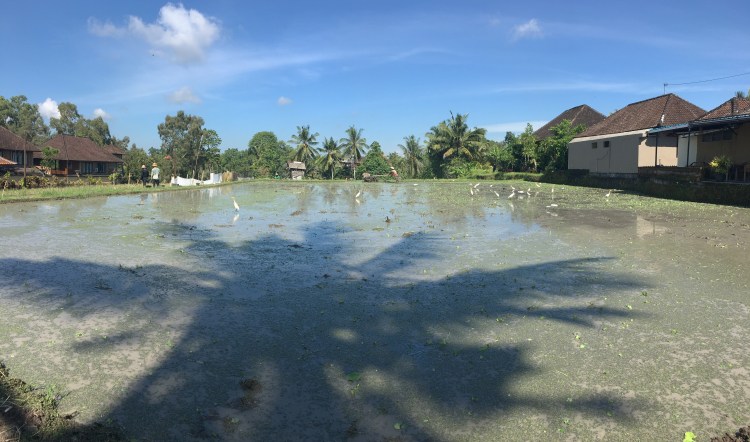
From the city it’s possible to do a walk along a ridge line to the edge of town. Along the way you pass by temples, guest houses, spas and retreats before coming out onto rice fields and farms. It’s a hot balmy day and the farmers are tending their rice fields. It’s planting time and the fields are being prepared. Hand-walked mechanical ploughs work the sodden grounds. It’s a fascinating sight to see ploughs working in watery mud. Egrets have learnt that this will give them great food gathering opportunities so the follow the plough. It’s an interesting relationship they have with the farmers.

The men work the ploughs but it’s mainly the women that plant the rice. Individual seedlings are hand planted into the mud under water a few centimeters deep. There is something disturbingly obvious here. Nearly all of the people working the fields are elderly. Very few young people involved. What does this mean for the future of rice farming in these places?

It rains every afternoon.

My tongue is still in agony. On advice from my Facebook friends, I sourced medicine from a pharmacy. The pharmacies here are staffed by young women who have a pretty aggressive selling technique. After finding what I wanted they insisted on all of these other treatments I needed. It was difficult saying ‘no’. Grabbed my medicine and ran away…