This is just a test blog to make sure things are working prior to my next overseas trip. Monday week I fly out of Cairns for two nights in Hong Kong before four weeks in Vietnam and Laos.
Saturday 8 December: Shanghai
The digital display in my carriage shows the train speed and it just keeps getting higher! It peaks at 430 km/hour. I try to take a photo of the display but it comes out blurry, partially because the carriage is shaking but mostly because I am shaking. I’m terrified!
I arrive at Shanghai Airport around 8am. My next flight onto Cairns departs from here at 9pm tonight. I have 12 hours to kill. Fortunately you can leave the airport without a visa if you are transferring flights so I decide to spend the time in the city centre. I can get there via the buses or metro but there is another option called Maglev. I imagine this to be an abbreviation for ‘magnetic levitation’. Why not give that a try?

The Maglev
It was an exhilarating experience. There are no seat belts and all I could think of as the thing reached 430km/hour how exposed I was if something went wrong. Even aero planes have seat belts. It doesn’t take you right into the city centre so I had to battle the metro to get the rest of the way. You can only buy tickets by machine and fortunately some locals help me.

Shanghai has some unique architecture in its centre. Probably the most recognizable building would be that tall tower with a ball-shaped centre. It’s Saturday and its so busy here. No signs of economic crisis here. There is plenty of high-end exclusive shopping here and Christmas is obviously big in this part of China at least. The displays are impressive. I do a bus tour of the city centre but there is no English commentary and the Guide apologizes. But that’s fine, I get the idea of things and I’m only killing time. I find a Cinema so why not catch a movie. There is an IMAX theatre and I find out the movie currently showing has English subtitles. I couldn’t work out what it was called so it was a mystery film experience for me. The result – it was called ‘Return to 1942’ and it was about the war between China and Japan just prior to WW2 and a drought and government bungling that caused 3 million people to starve to death in Hennen province. I came out of the film emotionally shattered. It was the saddest film I have ever seen. There was no happy Hollywood ending here. What the human spirit can endure!
I manage to retrace my steps to the airport without drama and my flight leaves on time. I arrive in Cairns at 8.30am. I’m so tired.
Thursday 6 December: Saigon again
I feel stuffed. I find another hotel in another part if Saigon that obviously doesn’t see too many tourists. What is the difference between Ho Chi Minh City and Saigon? The locals refer to the entire city as Ho Chi Minh but they call the city centre, or District 1, Saigon. This part of town is popular with the tourists. It has plenty to entertain visitors and of course all the facilities to make life easier for travelers.
Not much on the agenda but to rest a bit. Now having a beer in a cafe where the music is far too loud and a have a great view of the traffic. This might sound dull but I find the mix of traffic in Vietnam fascinating and I guess it is typical of any south-easy Asian country. The Vietnamese seem to be able to adapt the humble motor bike into any configuration you can think of and carry any load.
On the way back to my hotel a make the mistake again of admitting that I’m not married and a man offers his 43-year old sister, who is with him but can’t speak English. She can either speak some English or may have read my body language because she understood enough to know he deserved a slap! She was right – he did.
Wednesday 5 December: Hue
There are dingoes roaming the streets of Vietnam. To look at the dogs here you have the feeling you’ve seen them somewhere else. I have read that our dingo is descended from the Vietnamese dog and from my thorough investigation, I reckon they’re right! They look similar and display that similar sense of confidence and cunning.
Today is an easy one. I fly back to Saigon tonight at 9.30pm so I’m just filling in the day. It’s a chance to do a bit of shopping, for myself mainly! I have a beer at a restaurant on the Perfume River. From here you can look up the river and the old bridge, which was severed during the War, is coloured in changing lights. its a beautiful sight.
The weather has turned ugly and apparently there is a cyclone off the Phillipines that is having an effect here. There are gusting winds and rain squawls but nothing too serious. The flight goes to plan and I arrive in Saigon at 10.40pm and move into a hotel very close to the airport. It’s not a good location and the room is windowless so I will move tomorrow.
Friday 7 December: Vung Tau
Vung Tau is on the coast about 130km south east of Ho Chi Minh City and is a popular escape for Ho Chi Minh City residents. You can get there by bus but by hydrofoil is much faster taking just over an hour to make the journey. The French started using Vung Tau for its nice beaches back in the 1890’s.
I visit Vung Tau. The boat takes us up the busy Saigon River. We’re close to the mouth of the river and its wide. There are freight ships anchored everywhere.
Vung Tau was the main location for the Australians during the War. Today that link is still obvious. There are bars there with very Australian names and caricatures of kangaroos on signage. I am told Australians own some of the bars and restaurants here. They were involved in the fighting not far from here. Long Tan, where Australian troupes made a name for themselves against the Viet Cong, is about 50 kilometers away. Long Tan is near the town of Nui Dat. There is so much public information about the War and the American involvement but from the museums I visited there was little displayed about the other countries involved. I asked Nguyen, my friend in Hoi An who is a professional guide and has a great knowledge of history, what he knew of Australia’s involvement in the War. He was aware Australia was involved, along with New Zealand, Britain, Thailand, South Korea and the Philippines, but they were only involved in construction of facilities. He did seem to know we had combat troupes here and I didn’t tell him.
But how quickly time seems to heal. Today the young embrace America and everything American, despite the recent terrible war. I’m sure their parents and grandparents would have a different view.
We hire a pedal car who takes us on a small tour around Vung Tau. King Bao Dai had a residence here they is now a museum. It’s a beautiful old French styled building in a perfect location as you could imagine. The pedal-car driver then took us through town to the beach. The beaches here are ordinary but the water is cool and clean. On weekends people flock here from Ho Chi Minh City and right now there are new hotels under construction.
We return to Ho Chi Minh City and the rest of my time is spent packing. My flight leaves at 1.55am!
Tuesday 4 December: Khe Sanh
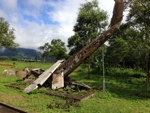
A huge US cargo and left behind at Khe Sanh
I’m doing a tour today. It’s 6am and I’m waiting for my bus on the steps of the travel agent where I bought my ticket. A middle-aged man and woman pull up in front of me on their motor bike, also carrying a large esky, plastic basket of stuff and about eight small plastic stools. I’m in their way and the woman gestures to me to move aside. She then proceeds to set up and within minutes, customers start rolling in. She is an instant breakfast cafe. Two school girls arrive on their push bike for breakfast, another lady comes for take-away, and another for a sit-down meal. I have seen another lady carry her business on her back. she had ones of those typical Asian slings that consist of a flattened pole with loads suspended from both ends. At one end were fresh vegetables and on the other was a large bubbling cooking pot complete with lighted fire. She would locate somewhere and start selling. Such is business in Vietnam.
It’s a big day today. The tour starts at 6am and we will return at 7pm. First stop is Khe Sanh, the site of a huge American military base up on a plateau just south of the old north/south Vietnam divide. At its peak in 1968 it accommodated 5,000 US marines and 1,000 south Vietnamese army. Today it is a monument to an embarrassing moment in the war for the Americans that ultimately turned the War against them. Poor intelligence had the US believing Khe Sanh was the centre of military attention. North Vietnam convinced them that they were planning a huge offensive on the base and while the US braced themselves here, north Vietnam attacked everywhere else, all at the same time. It was on the Tet holiday (30 January) in 1968 and it became known as the Tet offensive. The south Vietnam Army was caught napping. many troupes were celebrating the holiday. While this didn’t win the war for north Vietnam it provided the turning point. It was more of a psychological blow to the US particularly, because for the first time, Americans at home realized the War was not going the way they were being told.
Another failure of this base was its location. Based on a hill (khe sanh in local dialect), it was easily cut-off overland and unpredictable weather at seasonal times of the year made it difficult to access from the air. This led to supplies running precariously low at times.
There is little left at the Khe Sanh base now. There is a couple of tanks and a troupe-carrying helicopter, and a huge cargo plane on display. And there are also bits of helicopters collected together. The huge airstrip made from metal plates is gone, utilised by the resourceful locals. A museum gives a glimpse of what the base was like through static displays and photo,
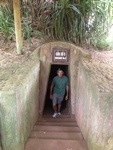
One of the many entrance/exits to the Vinh Moc tunnels
Next stop are the Vinh Moc tunnels. Near Saigon I visited the Cu Chi tunnels, which went for miles and were used by the Viet Cong to make surprise attacks on central Saigon. The Vinh Moc tunnels are very different. These tunnels, named after the local village, were built by the villagers to escape the American bombs. The tunnels formed a sophisticated network that could sustain a whole village for an extended amount of time. And where you had to crawl through the Cu Chi tunnels, these tunnels can be walked through comfortably. They had family living areas, a maternity ears and hospital, meeting rooms and kitchen. The network was multilayered. The first layer of tunnels went to 12 meters with the second layer down to 15 meters. The Americans countered with the ‘drilling bomb’. This bomb would drill into the ground to an amazing 15 meters before detonating. The villagers countered by digging special ‘drill bomb’ tunnels to 27 meters deep! The soil here is nearly solid clay so the digging would be laborious but reasonably soft. Seventeen babies were born over the six years these villagers had to endure the bombing. There are bomb holes every where. Over this time eight tons of bombs per person were dropped in this region.
On the way home we crossed the Ben Hai river that was the border between north and south Vietnam. There is a large memorial and war cemetery here for the North Vietnamese forces killed while fighting in this region. There are a lot of unmarked graves. To identify the dead, the Americans had dog tags. The north Vietnamese carried with them small medicine bottles with their details inside.
Monday 3 December: Hue
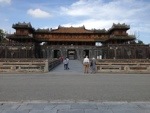
The entrance to the Imperial Citadel – the heart of Vietnamese culture
To come to Vietnam and not visit Hue would be a mistake. I think it is fair to say Hue is the cultural heart of Vietnam and there are some amazing expressions of that here. It used to be the capital of Vietnam and the most impressive feature is the Citadel, which is a walled enclosure on the northern side of the Perfume River. Ten kilometers of stone wall and moats protected the Imperial life that ruled Vietnam. Emperors of the Nguyen Dynasty, founded in 1802 by Emperor Gia Long, lived here until 30 August 1945 when Ho Chi Minh forced the abdication of Bao Dai, the last emperor. At this time the French were in charge and had effectively neutered the power and influence of the Emperor. King Bao Dai was just a puppet of the colonialists. I visited Bao Dai’s summer palace in Da Lat. Unfortunately the Citadel, with all of its beautiful and significant cultural buildings, was badly effected by the wars. Most damage it seems was done in 1947 when Ho Chi Minh took on the French. The heart of the Citadel, the Imperial Enclosure, there for the private purposes of the Emperor, was completely destroyed. Further damage occurred during the American War when America heavily bombed the entire city of Hue to take back control…temporarily. On a brighter side, UNESCO is coordinating the reconstruction of this cultural icon. The Citadel is now Heritage listed. Young Vietnamese are learning and applying important traditional skills to bring this place back to its former glory. Wood carvers, painters and builders are hard at work. The reconstructions are just stunningly beautiful and a credit to these new skillfull practitioners.
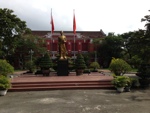
The famous National School where Ho Chi Minh and other influential Vietnamese spent time
I walk back across the Perfume River to visit another important institution. It’s the National School and is famous for producing some very influential people. Ho Chi Minh spent a year here in 1908. General Vo Nguyen Giap who famously defeated the French to end their 100 year rule studied here as did Prime Minister of Northern Vietnam Pham Van Dong. It’s one of the most famous secondary schools in Vietnam and enrolling there is very competitive. The School was built by the French in the 1890s I think and the facilities have that typical timeless French architecture. The buildings are beautiful and primed to inspire anyone who spends time here.
Walking back to my hotel a pas the Hue University. A Vietnamese is in the entrance on his bike and says hello. We strike up a conversation and he is waiting to pick up his daughter but is an hour early. He has time to kill. He has family in Queensland, an aunt in Brisbane and an uncle in Roma of all places. He is amazed I know where Roma is. Lee is his name and he buys me lunch. He tells me he is planning a ceremonial party tonight to wish all of his Australian family and friends well. He needs to buy wine so I offer to pay. His choice of wine was more than I thought I would be paying but what the heck – he is also blessing my father and family as well. So Family, consider yourselves blessed for a long and happy life by Lee and his family. Lee also has a different plan for my lack of marital status. He can set me up with a Vietnamese lady in Australia!
After a walk-around I finally find a place with strong wifi for uploading these blogs. For nearly a week I haven’t been able to publish my blogs. I was constipated with backed-up blogs! I hadn’t been able to access FaceBook either but nobody seemed too concerned! Feeling a little unloved but I’ll get over it…in time…after much therapy. I don’t understand wifi at all!
Sunday 2 December: Hoi An to Hue
It is difficult for the Vietnamese to comprehend a man my age being single and even harder, never being married. On hearing the news (because they all ask) they respond with a heart-felt ‘oh so sorry’. Initially I tried to explain that this is a very good way of life for me but they don’t understand. For them it is culturally so important to marry and have children. I don’t try and explain my contentment any more, just nod in acceptance of their concern. This concern is then followed with advice about how I could easily find a wife in Vietnam. Is it really that easy? Perhaps I’m more handsome than I know!! Hero, my guide on the bike tour, seriously wants to get me married to a local. He is going to select the best 10 women he can find for me to choose from! Women who are single, either through loss or missed opportunity, and are over 30, find it difficult to attract a local husband. Even my travel agent here has a sister in Hoi An looking for a husband. The idea of marrying and living in Vietnam is not un-appealing to me!
It’s an easy day today. Breakfast then another massage. Lee is a beautiful young girl who runs a massage and spa. She is the daughter (adopted daughter i think) of the lady who runs the travel agency next door, and cousin to Nguyen and his wife who run the cafe where I breakfast and caffeinate. The three shops are a family affair and they work so hard. They’re open seven days to 10pm. I’ve had two massages at Lee’s spa and she insists on giving me a free one. I want to pay but she insists. I sneak back hoping to get some money to her friend but that didn’t work out. I leave Lee a stuffed kangaroo with Aussie flag (made in China of course) as a gift and she is delighted, now proudly displayed in her shop. I mentioned I wanted to buy some real vietnamese coffee makers so she took me on her bike to a locals shop to get them cheap. She’s beautiful.
After a near 4-hour bus ride I arrive in Hue at 6pm. I’m picked up at the bus and taken to my hotel, all organised by my friendly travel agent in Hoi An. I live this country.
Saturday 1 December: My Son
Vietnam’s history is fascinatingly complex and takes some reading to comprehend. It is littered with invasions. One of the invaders were the Cham peoples. They came from Java in Indonesia and muscled their way into central coastal Vietnam. They are Hindus and established the Kingdom of Champa here in the late second century. Eventually they were forced out by the Vietnamese in the north after several centuries so their influence is still apparent. Descendants of the Cham now reside in the delta region of the far south and can be easily identified. They have a darker skin and curly hair when compared with the Vietnamese. Cham people’s were great builders of temples and monuments to their kings. The greatest example of this is not far from here at a site called My (pronounced ‘ me’) Son. This is where I go today.
The remains of their efforts can be found at My Son and are now protected by World Heritage. Sad this protection came too late. During The War the Americans bombed this area deliberately targeting the ruins because the Viet Cong were hiding there. Much damage was done to the precious constructions and there are huge bomb holes everywhere. Rather than cover these holes up, they keepers of this site leave them as they are to make the point. Our guide repeatedly talked of the American people’s being responsible for the destruction and desecration of the site. Richard Nuxon gets a mention as he should but I think it’s unfair to blame the American peoples. Many of the ‘peoples’ were against the war.
None-the-less much damage has been done and UNESCO is busily coordinating and funding the reconstruction of the temples. This isn’t easy because the construction techniques used by the Cham are still a mystery. Bricks are perfectly fitted together to not require any mortar to hold them. It reminded me of the skills of the Incas at Matchupitchu in Peru. They same peoples who built these temples at My Son also built Ankor Watt in Cambodia, but much earlier. Ornation decorating the temples expresses Hindu and Buddhism beliefs. Prior to the War the French removed many of the artifacts for spaces in The Louvre as well as museums in Danang. Ironically this save important elements from the destruction of The War.
It’s about 38 degrees and muggy – even uncomfortable for me. The trip back to Hoi An included a boat ride up the rive for a short stop at the old port. Hoi An was a major trading port until the river silted up rendering it inaccessible to serious boats. There is a tradition of wood carvers here and they are still at work today, plying their trade through the close scrutiny of many tourists.
Back to the city and I have a final fitting for my clothes. All is good and they are delivered to my hotel.
Tuesday 27 November: further north
Vietnam has a special day to commemorate their war dead and all those who participated in uniting Vietnam. It’s 26 July. We stop at a memorial site just outside Buon Ma Thout. There is a huge statue representing women, tribal people’s and soldiers, under two flags – the Vietnam flag and the hammer and sickle of the rural class and laborers. Into a marble wall is etched the names of fighters who gave their lives in the American War. Any war memorial encourages solemn and thoughtful moments and this one is no different. Each name represents a family torn apart by loss of loved ones and the families denied a chance at all. I feel the emotion despite the role my country played in these names being here.
Hero and I are heading north. Travelling this way as pillion on a bike with a local guide has huge advantages for me. I’m here to experience Vietnam, not just see it. The back of the bike provides a 3-dimensional experience for me. I get uninterrupted views (except for directly in front which is a good thing), the smells, the waves and greetings from curious onlookers (and ‘what are you about’ from some), and a running commentary from my guide. We stop anywhere of interest or for photographs. There are risks of course, being on a bike and very second class to the arrogant buses and cars but so far so good. The roads are in very poor condition so travel is slow.
We call into a family to have a look at their multi-layerd business. There are coffee trees and pepper bushes in the field. In the shed is a rice-whiskey distillery right next to pens of the happiest looking pigs I’ve ever seen. Perhaps the fumes from the whiskey distillery have something to do with it! The pigs get fed the by-product of the distilling process. They have one of those funny tractors and its a chance to see one up close. These Chinese-made beasts are a very common work horse in rural Vietnam. I get a go at the controls. The seat is just a wooden board! They must be bloody uncomfortable. Hero tells me they were a poor family but have done well through hard work and ingenuity. It’s nice to see.
Hero got a speeding ticket today. We were cruising through Pleiku at the same pace as other vehicles but we were singled out and Hero thinks its because he is carrying a tourist. He tells me to wait by the bike while he takes the policeman aside for a one-on-one chat. Speeding can come with a tough fine and confiscation of license so Hero opens his wallet and the policeman helps himself! This is the way it’s done here he explains later. Pleiku is a pretty city and is nicknamed Da Lat 2. It was a significant base for the Americans during the War.
We pull over at a rubber plantation. Luckily they are loading the harvest into bulk tankers so there is a great photo opportunity. What a curious business. There are countless trees in perfect rows bleeding their precious sap into cups. Collectors move through the trees and pour the cup contents into buckets before bringing the laden buckets back to the tanker for weighing. The smell is interesting and Hero reminds me it is the scent of making love! Trees are 7-years old before they are ready to harvest and finish their life at 35 years, when they are replaced.
It’s a big day and we arrive at our hotel just on sun down. We are in Kon Tum. It was heavily damaged in the War and is in an area of poor soils so production potential is weak. The people are relatively poor here I’m told. Productivity hasn’t been helped by the on-going effects of agent orange, which was used prolifically in this region. The town has been slow to develop but to my eye it is certainly catching up. There is much construction happening and a beautiful river provides an attractive centre piece.
The nightlife, in my part of town at least, is alive and relaxed. The people here are very friendly. From dinner I walk back by the river and there is a comfortable river-side cafe culture amongst the young. They’re there in numbers, eating and drinking and having fun. From my fourth-story balcony looking down I see young kids playing in the streets, avoiding the traffic with some uncanny skill. They must learn this as soon as they start walking. A wayward soccer ball is playfully rounded up by a passing bike rider and kicked back to the children. The sky is clear, the moon is full and it’s a very pleasant cool.
 angusmccoll