Friday 30 November: Hoi An

This morning I organise travel for the next few days. I find a travel agent on the street and book a tour for tomorrow, my bus to Hue and a flight from Hue back to Saigon. I’m the first customer so I get special ‘morning price’! Her daughter runs a massage and spa next door so I get a Thai massage, also for ‘special morning price’. During the massage the mood was interrupted a couple of times – once by the masseuse answering her mobile while continuing to massage me one handed and secondly from cigarette smoke wafting in from a neighbouring room. I wanted a coffee next so I was taken next door to the masseuse’s cousin who runs a cafe. No talk of ‘special morning price’ here but it is very cheap and genuine anyway. The cousin’s husband sees me going through the Lonely Plants guide and sits down for a chat. His English is good and we have a long and interesting discussion about the state of affairs in Vietnam. He has a very educated knowledge of world affairs as well as his country’s history. He is frustrated with the powerful over-controlling government and not being able to do anything about it. Vietnam is managed by a communist regime and the people don’t get to decide by vote who is in charge. Hero, my guide from the bike tour, has a more upbeat view of things. He describes the administration of Vietnam as being more ‘socialist’ than ‘communist’. My more pessimistic (or pragmatic) new friend sees thinks not. The corruption that is a big part of political life here is disparing and he doesn’t see that changing. There is big money flowing into a developing Vietnam and corrupt leaders are helping themselves. Positive change can only be influenced by powerful forces from outside of Vietnam. He sees a lot of pain to come for Vietnam because the growing economy is un-sustainable for many people. They have temporary wealth.

The afternoon is about a first fitting of my clothes. In just 24 hours my two pair of trousers, two pair of shorts and three shirts are ready for a fitting – amazing! Tourist pass through here so if they want to capture that market they have to be fast. I’m here for only three nights and my gear will easily be ready.

From there it’s a wander down to the river to a very old part of town. There is a famous old bridge built by the Japanese community here in the 1950s to connect them with the Chinese quarters across a stream. It’s beautiful down here and there are a mix of markets, some genuine and others for tourists.

Thursday 29 November: Hoi An

Sitting on the beach at Hoi An with a beer in hand right now after arriving here just after lunch. Five days on the back of a bike is enough for me physically but the experiences have been priceless. Hoi An is very touristy and I feel very uncomfortable amongst the ‘foreigners’ despite being one myself. I’m sure there are some nice ones. The water is beautiful here but cold I am told.

The day started typically with a breakfast of scrambled egg, coffee and mini french stick before hitting the road. We’re still on the Ho Chi Minh road and the scenery continues to impress. It’s beautiful jungle-covered mountainous country supporting the lives of various different hill tribes. Village after village
is evidence of their unique lifestyles. We call into a family who have a timber-cutting business. Father and sons are operating a big bandsaw to slice up a large bit of timber. They handle the operation very cautiously and Hero explains it’s because some of the timber they process can have metal schrapnel from the war embedded. The bandsaw would desinticrate on contact with the metal with dangerous consequences.

Next village and another family business. This time it’s rice paper. Outside of the kitchen are many drying racks, each with about 21 perfectly circled paper-thin rice papers dring in the sun. Inside there is the cook working over a hot smokey stove in an unbearably hot kitchen. With a special ladle she scoops up a sloppy mix of rice powder, water, oil and perhaps some sugar and drops onto a gently convexed hot plate. And with great skill she uses the bottom of the ladle to shape the mix into a perfect circle. This cooks briefly before picking up and placing on a rack. A second lady takes the circle of rice paper from there and onto a drying rack, which are placed in the sun. This is definately a dry weather operation.

We arrive in Hoi An and the end of the bike tour, around lunch time. Hoi An is popular with tourists for the beaches but also for the many tailor shops here that can provide you with tailor-made clothes for very reasonable prices. Hero takes me to one and straight away I’m measured up by a very cheeky young girl for shirts, trousers and shorts to be made to my shape (not easy). I return for fitting tomorrow and they will be ready for me the following day – amazing!

Wednesday 28 November: Ho Chi Minh Road

We lunch today at Dak Glei, a village named after the hills tribe whose land this is. An elderly gentleman greets me with a genuine warm smile. Hero tells me later he was a Viet Cong soldier during the War.

We’re following the famous Ho Chi Minh trail today. The Ho Chi Minh trail isn’t one path but a network of trails that provided a vital supply link for the North Vietnamese and the Viet Cong to the south, eventually arriving near Saigon. Soldiers and essential supplies used these trails extensively throughout the War. It’s mountainous country and visually stunning. We are presently about 2000m up. The trails also extended into neighboring Laos. To cripple the effectiveness of this supply route, the Americans bombed it heavily, including eastern Laos. The amount of bombs thrown at the trails provide baffling statistics breaking all sorts of records but non-the-less the Americans failed. The consequences of the bombing for Laos are still being felt today, with their land still littered with unexplored bombs. The type of bombs used were great voluminous things that were designed to disintegrate into hundreds of boomlets at a certain distance from the ground. Apparently these boomlets were very inefficient at exploding on impact but can remain active, and still do across the land. Farmers and children are still being killed, or worse, horribly maimed from these invidious things.

The road we are on today is the Ho Chi Minh road and it roughly follows the famous trail. This road is a sophisticated concrete highway that snakes it’s way around the mountains. It cuts right through the homelands of many different hill tribes. The region is very productive with cassava, coffee and tropical fruits, sometimes to the detriment of the countryside. Swathes of steep hill slopes are cleared for the purpose and erosion is very obvious.

We start our day at 8.30am with a cruise around Kon Tum. First stop is a Catholic church like none I have seen before. It’s one of the most beautiful churches I have ever seen and Hero admits its the most beautiful in Vietnam. It’s entirely made out of beautiful timber. Even the roof tiles are wooden. It’s being lovingly restored at the moment. Kon Tum is home to the Bana people’s. we visit a traditional longhouse, which is an important community space for meetings and ceremonies. We see these beautiful unique looking buildings often up here in the hills. Hero explains that they are poor people and its only since Vietnamese have moved into this area has this town really started to develop into a modern city. Some ladies are thrashing seed heads on the side of the road. They are harvesting the seed of some grass to make a spirit that will be used for special traditional occasions. They also make rice wine. They show me their shed filled with ceramic pots full of fermenting product. What a responsibility!

Outside of town we visit a war memorial on Horse Back Hill. Its strategic advantage made this hill a centre of much fighting during the War and there are still bomb holes as evidence. Kon Tum was nearly destroyed. The Americans would come and go here from their base in Pleiku. There is an old American airstrip not far from here. The long stretch of bitumen is now used to sun dry cassava.

Magic Hoi is the start of the Ho Chi Minh road if you’re heading north. It is also where the road to Laos starts. The Laosian border is just 14 kilometers away. We coffee at the road junction on coffee made from Laos/Vietnamese beans. It’s beautiful. We visit another war memorial commemorating all groups of peoples who helped with the war effort – hill tribesmen, soldiers and women.

I eventually get to sample a small part of the real Ho Chi Minh trail. Hero drops me off at a point and instructs me were to walk to meet him again down the road. The trail is a narrow track of bitumen that passes through a small group of houses. Its amazing to think this was alive with soldiers and vehicles of war fifty years ago. I cross a small bridge wearing a few bomb holes before I take a walking track through the jungle back onto the road. Hero is relieved to see me pop out of the jungle, perhaps thinking he might never see me again.

Monday 26 November: to Buon Ma Thuot

The day starts with a visit to an tourist elephant-riding place. I forgo the opportunity to go riding but I love being up close with these animals. There is a ‘knowing’ in their eyes that gives this animal a special place in my psyche. It’s no wonder they feature so highly in eastern mythology and religion. They are special.

We then go onto some waterfalls that are popular with the local tourists before we get to a curious place. We call into a home where they have pet pythons. They’re beautiful. I get to hold one. Also petted is a huge scorpion that the boy just picks up by the tail and places on his hand. This is a huge scorpion by Australian standards with large nippers and long tail. I’m amazed at seeing this. It’s a pet and doesn’t bite…apparently. I don’t have a nurse!

The boys grandfather isn’t here but he fought proudly in the War. He has the injuries to prove it and he doesn’t mind showing off the scars. He has plenty of medals for his work as a VC. He likes to tell the story about a time in the War when bomb landed right near him but failed to explode! He likes to go off into the jungle by himself. He rides his bike about 15 kilometers to get to the jungle and will lose himself for days. The pet snakes were gathered by him from one of these jungle escapes, when they were babies. I’m disappointed not to meet him. He is out in the jungle right now.

Some of the hilly countryside we are passing through is obviously scared and Hero tells me it is from the Agent Orange. There is a tree they grow on these hills to try and fix the problem. These trees bring health back to the soil and can be harvested for wood.

The day ends at a city called Buon Ma Thuot. It’s a fast-developing city in the central highlands in the middle if coffee country. As well as being a major trading place for the region, it sits on the juncture of many key highways that go in all directions. This made this city a significant strategic location during the War. Controllers of this place had important access to any direction. The VC gained control early in 1975 and six weeks later they were in Saigon, winning the War. This is off the tourist trail and I don’t see any other foreigners in my walk around.

Sunday 25 November: on the bike to Lak Resort

I’m on a bike tour! These are popular ways to tour around here. Your Guide has. Bike and you tailor an itinerary to suit yourself and off you go.

My guide/driver is Hero, about late 40s. He has a family in Da Lat and this is his business now. He has the business with one of his many brothers. He is part of a ‘football team’ sized family. Three brothers fought in the war. Two were injured and one killed.

The bike is not big but we, and our luggage, fit comfortably. It’s a great way to look around. You get perfect viewing, wind in your face, and all the information you want with a local knowledge of where to go. We escape Da Lat via a Buddhist temple, then a flower farm where we drop in and see them preparing the morning shipment for Saigon. Then onto a silkworm factory. What an amazing place this is. Silk worms create silken cacoons that are harvested via a complicated mechanical process. The naked cacoons with unborn moths are then sold off for food. The silk is also woven in this same factory. Beautiful stuff. And all the staff are beautiful young women – who is on the selection panel.

We make our way up into the hills and coffee country. Every inch of hill is coffee trees. The French introduced this industry and now the Vietnamese farmers are making the world, including me, happy. We drop into a farm where there produce a special brand of coffee. The harvest the seed from the dung of weasels (I think they are civets rather than weasels). The civets are housed in cages and are feed the fruit. A breeding pair keep the civet stock in supply. They also make a powerful rice whiskey here. One shot straight from the var gave me a serious ‘glow’!

We pass through a small village that is home to a hill tribe. They are coffee farmers now and every house has coffee seed drying in their yards and on the streets. It’s harvesting time. Village life is fairly under privileged and schools seem rare. The people here do look different to elsewhere with broader faces and darker skin. And they are quite short in stature.

We finish the day at a lake resort.

Saturday 24 November: around Da Lat

Interestingly Da Lat was spared the ravages of war through some agreement on both sides. I have read that military leaders on both sides used this place as a cool respite – the allied commanders in one corner and the Viet Cong in another corner. Such are the curious rules of war.

It has rained overnight in Da Lat and the city square is wet. There is a huge market place in the centre that is alive with anything you could possibly imagine. Fresh food of every description, and some that defies my simple vocabulary, is on sale here. Live fish in plastic buckets and prawns, and meats of all sorts on the chopping blocks and hanging up, vegetables beautifully displayed and fresh, many of which are very familiar. Even kids of Vietnam have broccoli to contend with. Mangoes and mangosteens are everywhere and cheap. I could go on but a special mention has to go to the live toads in big plastic containers enjoying their last bounce around. It’s so busy here and it’s a fight just to move through the crowds. I’ve been told entrepreneurs will buy product from other traders and resell as their own.

From there it’s on with the walking legs and a trusty map for a good trek around Da Lat. it’s hilly here so there are some great views for which hotels take the best advantage. I find a cafe down a narrow lane way that looks like a good chance for coffee. The proprietress doesn’t speak English but as soon as she recognizes I’m from not around here, off goes the Vietnamese music and on with country and western! I laughed out loud.

There is no plan to this walk, which is typical of my disorganised style, and I find myself at a place where people are cuing up to get in. I tag along. It’s one of the three emporial summer palaces where the Emperor of Vietnam used to stay. Emperor Bao Dai was the last to rule, escaping to France after the French capitulated to Ho Chi Minh in 1954. This summer palace is now open to tourists. It’s a fascinating insight into a non-typical lifestyle. The building itself is French-built Art Deco styled construction of a lot of marble and timber. Apparently the furnishings have been kept as they were in the time.

I catch up with Jimmy and his girl for dinner in a market eatery. The food was a bit ordinary.

Friday 23 November: Da Lat

Just arrived in Da Lat after 8 hours on the bus from Ho Chi Minh City I arrive here at 8.30pm. I meet Jimmy on the bus with his girl friend and follow them into town. They help me find this great cheap hotel in the city centre and right away I hit the streets. I love this place already. The centre is alive with food and markets and people and colour.

Jimmy is South Vietnam born but as the War finished, his family escaped to USA. His father worked for the US military so they got instant access to a new life there. He’s from Atlanta and has come back to Vietnam for a holiday with his Vietnamese girlfriend. He’s held onto the language despite a life away. Some of his brothers have moved back to Vietnam and have successful businesses here.

Da Lat is up in the hills and not that far from HCMC but the roads here are very slow, especially for big buses. It’s a French built city designed as a retreat for the colonist to escape the heat of Saigon. It’s noticeably cooler and will be home for me for three nights.

Da Lat has an interesting past but more about that tomorrow. For some reason it is a bit off the international tourist trail and that suits me fine. But it is a popular destination with local tourists.

Thursday 22 November: Cao Dai Great Temple + Cu Chi tunnel tour

‘My name is Phong and I am your guide today. I’m 29 years old and still not married. My parents worry. I’m not worried. Still plenty of time. There are two Vietnamese women on this tour. They are very beautiful’. Phong either wears his heart on his sleeve or he could easily get a gig in stand-up comedy. He is funny.

There are about 15 of us on this tour that will take us out of Ho Chi Minh City westward and close to the Cambodian border. We are going to visit Cao Dai Great Temple near Tay Ninh, then go onto a network of tunnels successfully used by the Viet Cong during The American War. They are near a town called Cu Chi and are known as the Cu Chi tunnels.

20121123-090316.jpg
Prayer in progress at the Cao Dai Great Temple.

The Cao Dai Great Temple is the headquarters of a uniquely Vietnamese religion called Cao Daism. It’s a fusion of Buddhism, Confucianism and Christianit,y and that is reflected in their tri-coloured flag, yellow, blue and red. As well as the temple, the complex houses admin offices, officials’ residences and a hospital of traditional herbal medicine. But it is the temple of course that stands out spectacularly. Not only is it huge but very colorful as well. And ornated all over with sculptures of elements of the religion. Dragons feature, as does the lotus flower but probably the most significant symbol is the single eye in a triangle where the points of the triangle represent heaven, hell and earth.

20121123-091918.jpg

Cao Daism has several million followers world wide. Vietnamese generally aren’t that concerned by religion with only about 20% admitting to following a faith. Buddhism is probably most popular.

For lunch the tour drops into a designated tourist cafe. I hate these places. They are over priced and full of processed crap and bad service. I deliberately avoid them plus I prefer to support other parts of the village. This comes with its challenges though. It’s unlikely you will find English in these local eateries. I just shrug my shoulders and take what I am given – a mystery meal that is genuine and cheap.

The Cu Chi tunnels played an important part to the Viet Cong during the War. These impressive tunnels gave the VC underground access to Saigon, 65 kilometers away. They used this access to make surprise and demoralising attacks at the heart of the South Vietnamese regime. The Cu Chi tunnels are well set up for showing us all the tricks the VC used to attack their enemy and Phong seems to delight in showing us. Even some of the most hideous traps are explained with a bit too much exuberance. Bamboo spikes at the bottom of pits and swinging frames covered in spikes are just some of the bag-of-tricks that turn the stomach. But it is the tunnel networks that are impressive. The VC could live entirely underground for periods of time with underground food stores, water wells and kitchens that could cleverly disperse smoke to not give away the location. Three layers of tunnels were built in places at a maximum depth of 10 meters. On the surface they were invisible and the Americans could never get on top of this sneaky type of warfare. There is gun fire in the distance. At the end of these demonstrations of VC cunning was a rifle range where you could pay to try some of the weapons of this war. M16s, M60s and even the Russian AK47 were some of the guns you could try your hand at. I had a splitting headache already and spent the whole time with my fingers in my ears. I couldn’t get over how loud these damn things were in the jungle. What an un-nerving sound!

We also learnt how the VC made their uniforms underground and how they made their footwear out of recycled rubber tyres in such a shape that left directionless tracks. They thought of everything. Then there were demonstration tunnels made big enough for fat tourists to try. We did. What an experience. We crawled through this claustrophobic space for 60 meters. As clever as this tunnel living was, it was a tough life in the humidity and malarial infested environment that the rainforest offered.

Wednesday 21 November: Ho Chi Minh City, day 3

20121121-180647.jpg
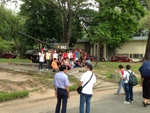
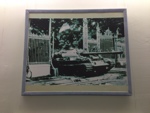
Children stand proudly in front of the tanks that crashed through the palace gates to signal the end to the American War. The tanks are now immortalised in the palace grounds.

‘The Chinese were here for 1000 years, the French 100 years, the Americans 10 years…now all gone’ is the proud catch-cry of our tour guide in reference to the many invaders of Vietnam. He talks of Ho Chi Minh as his president. Why not. To my mind Ho Chi Minh was one of the great leaders of modern times. He was responsible for defeating the French and the Americans.

I did a half-day tour of the city this afternoon. It took in the Notre Dame Cathedral built by the French of course, in about 1880. They even brought their own rock to build this formidable church. Christianity had arrived to IndoChina. Across from it is the French built central post office. Also very impressive, it is a functioning post office but also a major tourist attraction here. Customers gave to fight with a throng of tourists to do their business. The tour also took in the Reunification Palace, which I saw yesterday.

Also on this tour are an interesting mix of people from other Asian countries (including locals), France and Australia. An elderly Australian couple …well …older than me…are visiting Vietnam to follow where Australian forces were involved in The War. Joyce’s brother fought here. He is damaged from the experience and is too unwell to come here himself. Joyce will trace his footsteps with her husband. They are a typical Australian type, the type you are proud of being part of. By the end of the tour they had invited the entire mixed tour group back for a beer. Few will of course but they are appreciative of this very Aussie gesture.

20121121-201605.jpg

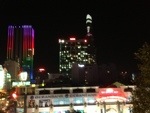
I end the day with a beer at the Garden Bar atop the beautiful old Rex Hotel. The hotel is French designed and is just classically stunning. The French certainly know about timeless architecture. It’s dusk and the lights are coming on. The cityscape view from this location could be anywhere in the modern world – such is the economic advancement of Vietnam.

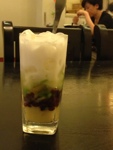
The Rex Hotel is way too upmarket for dinner so a find something way more affordable at street level. I’m on my own tonight so its a case of choosing food by the pictures. Caution is out the window and curiosity is king for now so I choose this drink. The surprised look on the waitress’s face suggested a possible mistake on my part! I still don’t know what it is made of but it’s tasty as well as colorful.

20121121-200742.jpg

Tuesday 20 November: Ho Chi Minh city, day 2

20121120-175320.jpg

Sam Lee, my guide, explains to me the war museums in Ho Chi Minh City (HCMS) have ‘softened’ their anti-American rhetoric to win back favour with the USA to encourage trade and investment. Much of the photos and displays have been removed. With this in mind I visited the War Remnants Museum.

Wow! If the information here has been ‘softened’ I would hate to see the full Vietnamese version of events. It was overwhelming. Any big wars come at great human and material cost but the legacy of this conflict continues to be felt today. The indiscriminate nature of the American effort is many fold and hard to comprehend. More bombs were dropped on Vietnam and Laos by the USA in 14 months than their entire effort in WW2. But so many of these bombs remain active to this day and still claiming lives. And the toxic dioxin chemicals poured over the rain forests and productive farm lands to remove the protective cover of Viet Cong supply lines and food production, also contaminated 4 million Vietnamese according to the statistics. Many unknowing American soldiers were also poisoned. The legacy of this action is also still being felt. The genotoxic nature of these chemicals is on display through many photos of horribly deformed human lives. Three generations have been scarred.

The on-going legacies of the unexplored bombs still littering the landscape and the long-term effects of the dioxin chemicals make this the dirtiest war of all to my mind.

The day started with a visit to the busy Saigon River, then an elevator ride to the lookout in the tallest skyscraper in town. The Bitexto Financial Tower is new and big but is also testament to HCMC’s, and Vietnam’s advance to the modern world. It symbolises economic success, as do the many up-market shopping centers that splatter central HCMC.

20121120-183949.jpg
The crassness of Christmas is alive and well in HCMC.