Arequipa is the second largest city in Peru behind Lima and has a population of over one million people and two million dogs (just guessing). This city is a bit different to other places in Peru in that it’s origins have no Inca connections. It’s purely a Spanish idea. I suspect they built it here to service the surrounding mining industry. The people don’t identify themselves with Inca heritage so tend to distance themselves culturally from the peoples of surrounding regions. They even attempted to declare themselves a separate region within Peru. That didn’t happen but there are many things here that are distinctly Arequipa and not found or done elsewhere. They have their own foods, chocolates and alcohols. Some say the chocolate from here is better than Swiss chocolate. Research has concluded they could be right, however the question will require more scrutiny. They are a proud people.
Arequipa and this whole region is geologically active. The city is surrounded by volcanoes, some still quietly active. And the region has had it’s share if earthquakes. Every village and city have their own earthquake story. Arequipa was severely damaged in the 1830s and underwent considerable reconstruction. The latest was in 2001. There are no high-rise buildings here, just multi-storied ones.
Today I visit and old monastery. The Monasterio de Santa Catalina (or the Santa Catalina Monastery) is a complex citadel within the city. It has it’s own streets and is separated from the rest of the city of Arequipa by imposing stone walls. The Monastery was founded in 1580 by a rich widow who was careful to select her nuns from the best Spanish family’s. A tour through the old monastery revealed a side of life completely foreign to me. I just can’t get my head around this stuff – a surrendering of a normal life to a religious cause.
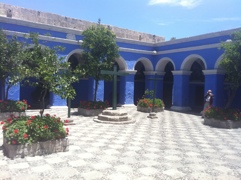
But I doubt all of the nuns went into this vocation voluntarily. Families were motivated to donate at least one of their girls to the monastery so they, the family, would be assured a blessed life. For a while though, the surrender of a normal life wasn’t entire complete. Nuns had servants and slaves, and hosted parties and visiting musicians. That came to a sudden stop when the Pope got wind of the liberal life here and sent in his big guns in the form of Sister Josepha Cadena. She freed the servants and slaves, some of whom stayed on as nuns. The Monastery remained behind closed doors and mysterious until it was opened in 1970 to the public and tourism, as per the instructions of the Mayor or Arequipa. Today the old Monastery is a museum and a visit there gives you a beautiful insight into how life was for the nuns. The monastery is still operating in new buildings next door.
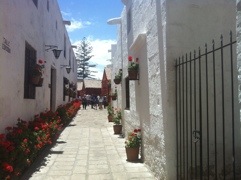
One of the streets in the monastery.
Peruvian Airlines took me back to Lima, arriving at 11pm. Thus airline is one if the cheaper options for flying in South America but they run rarely on time.
 angusmccoll