I have had another ‘tears to the eyes’ experience today and the magnificent condors are responsible.
The day starts with breakfast at 5am then onto the bus and off by 6.30am. Why so early? We have to be at a certain location where the condors are known to live. For a brief moment in the day they soar, catching the thermals thrown up by the Colca canyon and we have to time our arrival for then.
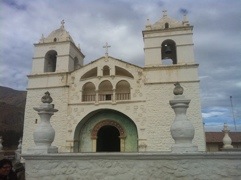
As already mentioned, Chivay sits near the head of the Colca Canyon. Already the canyon is deep here but this is only the start of the Colca River’s mighty work. The road we are on follows the canyon. On the way we pass through villages, each with their striking old church and town square. We are not the only bus on this path to the condors. Every stop we make at a village or look-out is in company with many other tour buses and of course local markets. There are always some ladies done up in traditional dress who are happy to provide you with a traditional experience for a small fee. Some even have a Llama with them for added appeal. I have heard that Llamas spit in defense. I saw my first Llama spit today and it was hilarious. This poor thing was surrounded by patting tourists and it had obviously had enough. It let blast. The victim was a young boy who came along at the wrong time. Everyone around laughed. It is more of a very wet sneeze than a spit!
For an added feature at this village it is possible to have your photo taken with an eagle. These huge beautiful birds of prey obeyed every command given by the handler, which was to sit on the arms or heads of paying customers. Photos would be taken and the handlers would swiftly shunt the birds onto the next customer – very slick operation!
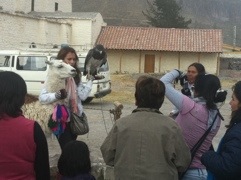
Pay extra and you can get a Llama and eagle experience together!
At this end of the canyon it is a wide open valley that is utilized fully by farmers. Incas introduced serious terracing up the sides of impossible slopes as well as water channelling. Apparently water channels that were built 1,500 years ago are still being used today. The terraced farming is amazing to see and reminds me a bit of the manicured mountain slopes in Nepal. Much of the terracing has been let to deteriorate as labour shortages makes maintenance difficult. The young men are moving to the cities or taking up jobs with the mines (sounds familiar). Everything is grown here. I have heard that there are 3,000 types if potatoes grown in Peru. I think a lit of them are grown here, as well as grains of all sorts. The views from the road overlooking this valley of terraces and villages is testament to man’s ability to utilise any resource. This vally is a patchwork of colours as different crops are at different levels of maturity.
The road winds precariously in the edge if and escarpment until we finally round a corner to get to the condor viewing park. There are already tens of busses and hundreds if tourists there! What a site. Anyway the condors are playing their part and sail pass the masses as if by instruction or remote control. Despite the overwhelming chaotic company it it still awesome to look up and see these huge magnificent birds of prey soaring within meters of your head. It was another special moment for me. They have that distinctive splayed wing tips where the large feathers finger out. Just striking! There were quite a few of them here circling for prey but it was all for a brief amount of time. After an hour or two they leave the skies and the buses pack up their passengers and away they go.
The canyon at this site is extraordinarily rugged and steep and you can just see the Colca River busily working away at the very bottom. There isn’t any farming here. At certain points the canyon reaches 3,000 meters deep, which is much deeper than the Grand Canyon.
We get back to Arequepa at 4pm
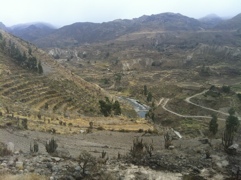
The terraced slopes of the Colca Valley.
-16.400070
-71.538147





 angusmccoll